Back in the tropics
It’s 4:00 am, still dark. The temperature is barely above freezing and there is a heavy, drizzly rain falling. An icy wind blows the rain in gusts against me and my fellow bus passengers as we stand exposed under a high roof at the Nogales border crossing. I am on my way north, to Tucson, to catch a series of flights that will bring me to Belize City tomorrow afternoon.
Arriving in Tucson, I am the first one off the bus, but by the time I find my damn luggage ticket the only taxi is full. The desk clerk tells me he has called a guy to take me where I want to go, or he can order me a real taxi. I accept the bogus cab ride because I don’t know how long my cash will take me. So we bump and grind our way across Tucson in an old beater with a broken side view mirror (a previous near-miss, I gather), pocked windshield, broken seatbelt, and scraps of fabric hanging from the ceiling. It saves me ten bucks and I arrive safely so all is well.
My good friend Sonnie and her daughter Liz collect my international mail, and feed and house me when I come to town. Liz loaned me her car so I could make a few last-minute purchases. Thanks, Liz. I leave at 5:25, so I don’t get to say goodbye. Thanks, Sonnie.
It is still dark and pouring rain in Tucson as I ride to the airport. Earlier tonight the winds were so bad they closed the Phoenix airport (there were tornado warnings all over the state) but this morning the air is calm and by the time we take off, the sky is starting to clear. Check-in and security go smoothly and I have time to spare before my first of three flights. My only concern about timing will happen when I get to Belize City. If they search my bags, I will probably miss my flight to Dangriga. As it turns out they only ask me a few questions and let me go. I get to the departure lounge with plenty of time to spare: five whole minutes.
I love flying in these Cessna Caravans. You never see a fifteen-passenger single-prop plane anymore. The view of the coast is spectacular: out the port window you see the sea below and the islands that huddle behind the barrier reef. Out the starboard window is the swampy coastal plain, a broad, flat expanse of savannah, dotted with lakes and marshes. The coast itself is a long line of sand, with the submerged sandbars visible through the clear water. I watch for manatees along the line of seagrass that parallels the shore just beyond the last sandbar, but all I see are the remaining hulks of a couple of wrecked ships.
At the airport in Dangriga, I meet Sue and Aaron, a Philly couple who are going to Glover’s Reef. We all pile into the Island Expeditions Toyota Hi-Lux, and in no time I am back in the “Clubhouse” exhausted and sweating.
To all my friends in San Carlos, take care, have a good rest of the winter, and I’ll see you in May. More to come soon.
Sunday, January 24, 2010


Wednesday, November 11, 2009
I found a great quote recently, about the effects of natural selection on cultural evolution, using the Polynesian canoe as a model. Translated from the original French, is this quote, from the French philosopher Alain (Émile-Auguste Chartier) in 1908.
Every boat is copied from another boat...it is the sea herself who fashions the boats choosing those which function and destroying the rest.
As a selective force, the sea can indeed be very powerful. This, needless to say, is the source of much worry for seafarers, but it is also the driving force behind us, more so than the wind itself. For of what use is a voyage if it does not test us? It must test our seaworthiness, in every sense, from the craft itself to the skills and strengths of those who sail her. It tests the seaworthiness of our judgement, our knowledge, our alertness, our stamina. If we are found seaworthy, in the conditions nature throws at us, we will reach our intended shore and it will mean something to us, that we have passed a rigorous test indeed and were not destroyed.
As this is my voyage, from top to bottom, and all the building, planning, outfitting, navigating etc. are my project, then it is I alone who am being tested. Am I seaworthy? Time will tell. The first Manatee ran into a few flaws, and they were fixed with no real harm done, until the last one. But by then I had already deemed the boat unfit for such a voyage as I had planned, so the loss was small. And more was learned by that simple shipwrecking, than was lost to me in the event. The second Manatee will be all the better-built for it, and I will be better prepared for the next failure, whatever it may be.
Still, whatever events I may plan for, I am sure the sea will be throwing up new ones at me, even unto the day I arrive at my destination, after months of sailing. And more complicated than one finds aboard any ordinary sailboat, is the fact that this boat and I must be able to land on the beach, time after time. The deep blue sea has dangers enough, but any sailor will tell you the most dangerous place in the whole ocean of the world, is the place where it collides with the land: an unstoppable force meeting an immoveable object.
So will the Manatee II and I be seaworthy and shoreworthy? Time and tide will tell.
Every boat is copied from another boat...it is the sea herself who fashions the boats choosing those which function and destroying the rest.
As a selective force, the sea can indeed be very powerful. This, needless to say, is the source of much worry for seafarers, but it is also the driving force behind us, more so than the wind itself. For of what use is a voyage if it does not test us? It must test our seaworthiness, in every sense, from the craft itself to the skills and strengths of those who sail her. It tests the seaworthiness of our judgement, our knowledge, our alertness, our stamina. If we are found seaworthy, in the conditions nature throws at us, we will reach our intended shore and it will mean something to us, that we have passed a rigorous test indeed and were not destroyed.
As this is my voyage, from top to bottom, and all the building, planning, outfitting, navigating etc. are my project, then it is I alone who am being tested. Am I seaworthy? Time will tell. The first Manatee ran into a few flaws, and they were fixed with no real harm done, until the last one. But by then I had already deemed the boat unfit for such a voyage as I had planned, so the loss was small. And more was learned by that simple shipwrecking, than was lost to me in the event. The second Manatee will be all the better-built for it, and I will be better prepared for the next failure, whatever it may be.
Still, whatever events I may plan for, I am sure the sea will be throwing up new ones at me, even unto the day I arrive at my destination, after months of sailing. And more complicated than one finds aboard any ordinary sailboat, is the fact that this boat and I must be able to land on the beach, time after time. The deep blue sea has dangers enough, but any sailor will tell you the most dangerous place in the whole ocean of the world, is the place where it collides with the land: an unstoppable force meeting an immoveable object.
So will the Manatee II and I be seaworthy and shoreworthy? Time and tide will tell.
Friday, September 25, 2009
There have been many stories written about a future without mankind. What will cities look like after the last humans have left? The stories usually portray a gradual erosion of buildings and roads. I have seen how it will really happen. Long periods without change will be punctuated by the abrupt collapse of buildings, utility poles, the sudden washing away of roads, and breakage of pipes and conduits. Time will gradually weaken structures, but it will be storms that knock it all down.
Imagine 36 hours of one-inch-per-hour rains, flowing over hard desert soils. A river of mud and debris will take out strings of power poles, float boats out of storage yards and pile them up on roads, wash cars into the sea. Drainage courses in the desert are dry so much of the time, that people build their houses, put up walls and fences right in or across them, as if they were a mere dip in the landscape and nothing to be concerned about. But walls become dams, and when they are knocked over, the resulting flood can be devastating. And when water and mud flow in under doors it can be terrifying.
Hurricane Jimena never officially touched the mainland in the Guaymas area, but it parked itself in the middle of the Gulf of California for a day and a half, and the sustained heavy rains cut roads in half and washed whole houses away, especially in poor areas. Two weeks later we have electricity and water again, but thousands are homeless, there is still debris on the roads and detours around the washed out sections. Everything will eventually be restored, but the breakdown from a single, if rare, storm is immense. This is how it will all happen when we finally leave this planet, or when, like the Mayans, we abandon our cities and our civilisation and return to a stone age culture. Hopefully that time is a long way off.
Meanwhile, life goes on in San Carlos. I for one am still acclimating to the humid heat after a wonderful five weeks in Ontario. If there is anyone who doubts the effect of humidity on the sensation of heat, or cold for that matter, think of it in terms of conductivity. Moisture in the air is like metal in the hand, versus something less conductive, like wood or plastic. And humid heat is unrelieved by sweat, which clings to clothing and skin, instead of evaporating and cooling the body. As much as I love my life here, I long for the cool fresh air of a Canadian summer and fall.
Lorena and I are considering spending more time in Canada. Since we migrate north every summer, we might as well stay longer, and make some money. This way we can avoid the extremes of temperature in both countries, and enjoy the best of what they have to offer. The tricky part is to find seasonal work so that we can come back to it every summer, and always have the job waiting for us.
Wish us luck.
Cheers
Jack
Imagine 36 hours of one-inch-per-hour rains, flowing over hard desert soils. A river of mud and debris will take out strings of power poles, float boats out of storage yards and pile them up on roads, wash cars into the sea. Drainage courses in the desert are dry so much of the time, that people build their houses, put up walls and fences right in or across them, as if they were a mere dip in the landscape and nothing to be concerned about. But walls become dams, and when they are knocked over, the resulting flood can be devastating. And when water and mud flow in under doors it can be terrifying.
Hurricane Jimena never officially touched the mainland in the Guaymas area, but it parked itself in the middle of the Gulf of California for a day and a half, and the sustained heavy rains cut roads in half and washed whole houses away, especially in poor areas. Two weeks later we have electricity and water again, but thousands are homeless, there is still debris on the roads and detours around the washed out sections. Everything will eventually be restored, but the breakdown from a single, if rare, storm is immense. This is how it will all happen when we finally leave this planet, or when, like the Mayans, we abandon our cities and our civilisation and return to a stone age culture. Hopefully that time is a long way off.
Meanwhile, life goes on in San Carlos. I for one am still acclimating to the humid heat after a wonderful five weeks in Ontario. If there is anyone who doubts the effect of humidity on the sensation of heat, or cold for that matter, think of it in terms of conductivity. Moisture in the air is like metal in the hand, versus something less conductive, like wood or plastic. And humid heat is unrelieved by sweat, which clings to clothing and skin, instead of evaporating and cooling the body. As much as I love my life here, I long for the cool fresh air of a Canadian summer and fall.
Lorena and I are considering spending more time in Canada. Since we migrate north every summer, we might as well stay longer, and make some money. This way we can avoid the extremes of temperature in both countries, and enjoy the best of what they have to offer. The tricky part is to find seasonal work so that we can come back to it every summer, and always have the job waiting for us.
Wish us luck.
Cheers
Jack
Sunday, September 06, 2009
Lake Talon, 31 August, night
A pregnant moon lays a silver path across the still, black water. A thin layer of mist dances and swirls slowly over the surface . Outside the temperature is already just a few degrees above freezing, but in the bathroom, a small electric heater has kept it the toastiest room in the cottage.
I am reluctant to emerge from this sanctuary of warmth, to cross the chilly, uninsulated main lodge to the insulated, if unheated bedroom. Quickly I shiver under a down blanket and am snuggled again against my warm other half. This is life at the cottage in late summer, or at least a glimpse.
Soon we are up, getting the fire going and starting breakfast. The morning sun has lifted the night mist off the lake, and it is a bright, cheery day.
This cottage is the anchor for the Wilde family. We try to all get here when we can, to share our old stories, and make up new ones, with family and friends new and old. The building itself expresses the history of the various families that owned it, with all the various additions , the rearranged rooms, and the mismatched dishes and cutlery. Legally it belongs to my brother, Alex. This was Dad’s idea: he has seen too many family conflicts when various siblings co-own a cottage, and can’t agree on modifications and repairs, who will pay for what, and who uses it when. Management of the family cottage needs to be a dictatorship. And Alex has been a benevolent dictator, making sure it remains the Wilde family cottage.
Alex has a young family and a new farm, so the cottage has become a necessarily low priority. So when we arrived in early August, we found that this petty fiefdom had been conquered by ravaging hordes of tiny Visigoths resembling nothing more than mice and chipmunks. Also, an ill-timed family accident led the cottage to be temporarily abandoned one fall, resulting in frozen water pipes. So our first priorities were to clean out the mouse-befouled cupboards and counters, remove debris and scattered clothing and toys, and to restore the water supply to kitchen and bathroom.
Under the cottage, the copper tubing had blown out at several elbows. Just a few joints to resolder, no pipes to replace. A borrowed torch from next door, and a bit of cursing and a few burned fingers, and the job of reconnecting the pipes is done without burning down the building. I broke a plastic connector attached to the pressure tank, and managed to free it by melting it with the torch without damaging the bladder inside the tank. So everything is good from the pump to the kitchen sink and toilet.
Next is the water supply from the lake. When the ice came in it pushed the waterline right up onto the beach and broke it off at the edge of shore. It also pushed it up underground putting a kink in the line. So the kids dug up the line and found the blockage, and when we were done, the waterline was good from the pump to the lake.
Prepared for the triumphant sound of water flowing in the pipes, I filled the pipe to the lake, connected it to the pump, and then began to fill the pump. And, of course, triumph turns to defeat as water pours out through a gaping crack in the side of the pump. Shit. So now it is a trip to town to buy a used pump.
Hooking up the pump to 220V, I turned off the switch so the wires would be safe to handle. It wasn’t until I tried to turn it on that I discovered the switch was somehow bypassed and useless, and if it weren’t for the fact that the power was turned off at the main panel upstairs, I wouldn’t be typing this.
Anyway, the new pump worked once we had adjusted the pressure so that it didn’t blow the hose off every time it turned off. So we have a flushing toilet and water in the kitchen. The place is clean and orderly. Life is good. We still have to heat water on the stove, but we use the electric one for that, and a shower is a simple matter of standing in the tub and pouring hot water over your body with a dipper.
The reason we come up to Ontario in August is to split our summer into manageable halves. The summer monsoon in Sonora runs from July to early October, and is both hot and humid. So by coming to North Bay in August, although we miss the best of summer weather here, we also miss the worst of the summer down south. And we can appreciate the cool and even the cold, wet weather, as a pleasant change to extreme moist heat.
Today, however, is perfect. Sunny and clear, the day promises to be warm and dry. The lake is a bit chilly, but we can swim until late October in Sonora, so we don’t miss it as much as we might if we lived here year-round. That said, there is nothing like swimming in a warm freshwater lake. No chlorinated pool and no salty sea can compare with the joy of freshwater. I like the sea, especially snorkelling in it, for all there is to see. But it is nice to not have to rinse the salt off of you. And of you swallow a bit of lake water, you are less thirsty for it, not more.
Today we might take the SS Entropy for a stroll down the lake, maybe see if our neighbours are around. The Entropy has seen better days. A pontoon boat is like a floating dock you can drive around the lake. It has a big flat deck, and lots of comfy chairs and couches to sit on. The problem is that the sun and the rain eat away at the upholstery, the carpeted deck stays wet long after a rain, and traps mildew and sand, and eventually the boat looks like an abandoned convertible on some redneck’s front lawn. So next year we are going to replace the carpeted deck with cedar decking, and the upholstered chairs can be replaced with cedar lawn furniture. Then it will still look like a floating dock but will be much easier to maintain and will look good for years.
Lake Talon is a lovely lake. Most of the shore and surrounding terrain is Crown land, with a scattering of cottages and a few permanent homes. It is all surrounded by a mixed forest, dominated by pines near shore, and a mixture of spruce, fir, poplar, birch and maple on the slopes. High hills surround the lake and except for the cottages and a few boats, it looks like the middle of wilderness. And it will stay that way because the crown has no intention of releasing any more land. Much longer than it is wide, it is a crooked series of bays and inlets, giving it a long shoreline but no really big open water. So it is ideal for exploring by canoe or motorboat. Most of the shore is bouldery, but there are plenty of rocky outcrops and some nice sandy beaches for picnicking. There is very little boat traffic on the lake, even in summer, and at this time of the year you practically feel like you have the lake to yourself.
The lake is part of the Mattawa River, and is part of an ancient canoe route stretching across the country. At one time the portages were marked with a signpost, and each had a large brass plaque outlining the history of the river and of that particular portage. Now the portages are hard to find, though they are all still used all summer by adventurous paddlers, and during the annual North Bay to Mattawa canoe race.
Being surrounded by so much Crown land has really spoiled me. The idea that you can just push off shore in a canoe and go for days or weeks, camping anywhere suitable, catch fish for dinner, and just wander at will without having to ask anyone for permission or pay a fee seemed the most natural thing in the world to me growing up here. Now I see how rare a thing this is I feel especially lucky to have grown up here. And to have a cottage surrounded in Crown land is a rare and lucky thing. I hope it always remains like this.
A postscript: While we were away in beautiful Northern Ontario, our lovely San Carlos got hit by Hurricane Jimena. Strong winds and heavy rain battered the poor town for 36 hours, dumping nearly a half a metre of rain. As far as we know our friends in San Carlos and neighbouring Guaymas are still trapped there with no water, no electricity and the highways washed out in both directions. We wish them all the best. Please eat the food in our fridge!
A pregnant moon lays a silver path across the still, black water. A thin layer of mist dances and swirls slowly over the surface . Outside the temperature is already just a few degrees above freezing, but in the bathroom, a small electric heater has kept it the toastiest room in the cottage.
I am reluctant to emerge from this sanctuary of warmth, to cross the chilly, uninsulated main lodge to the insulated, if unheated bedroom. Quickly I shiver under a down blanket and am snuggled again against my warm other half. This is life at the cottage in late summer, or at least a glimpse.
Soon we are up, getting the fire going and starting breakfast. The morning sun has lifted the night mist off the lake, and it is a bright, cheery day.
This cottage is the anchor for the Wilde family. We try to all get here when we can, to share our old stories, and make up new ones, with family and friends new and old. The building itself expresses the history of the various families that owned it, with all the various additions , the rearranged rooms, and the mismatched dishes and cutlery. Legally it belongs to my brother, Alex. This was Dad’s idea: he has seen too many family conflicts when various siblings co-own a cottage, and can’t agree on modifications and repairs, who will pay for what, and who uses it when. Management of the family cottage needs to be a dictatorship. And Alex has been a benevolent dictator, making sure it remains the Wilde family cottage.
Alex has a young family and a new farm, so the cottage has become a necessarily low priority. So when we arrived in early August, we found that this petty fiefdom had been conquered by ravaging hordes of tiny Visigoths resembling nothing more than mice and chipmunks. Also, an ill-timed family accident led the cottage to be temporarily abandoned one fall, resulting in frozen water pipes. So our first priorities were to clean out the mouse-befouled cupboards and counters, remove debris and scattered clothing and toys, and to restore the water supply to kitchen and bathroom.
Under the cottage, the copper tubing had blown out at several elbows. Just a few joints to resolder, no pipes to replace. A borrowed torch from next door, and a bit of cursing and a few burned fingers, and the job of reconnecting the pipes is done without burning down the building. I broke a plastic connector attached to the pressure tank, and managed to free it by melting it with the torch without damaging the bladder inside the tank. So everything is good from the pump to the kitchen sink and toilet.
Next is the water supply from the lake. When the ice came in it pushed the waterline right up onto the beach and broke it off at the edge of shore. It also pushed it up underground putting a kink in the line. So the kids dug up the line and found the blockage, and when we were done, the waterline was good from the pump to the lake.
Prepared for the triumphant sound of water flowing in the pipes, I filled the pipe to the lake, connected it to the pump, and then began to fill the pump. And, of course, triumph turns to defeat as water pours out through a gaping crack in the side of the pump. Shit. So now it is a trip to town to buy a used pump.
Hooking up the pump to 220V, I turned off the switch so the wires would be safe to handle. It wasn’t until I tried to turn it on that I discovered the switch was somehow bypassed and useless, and if it weren’t for the fact that the power was turned off at the main panel upstairs, I wouldn’t be typing this.
Anyway, the new pump worked once we had adjusted the pressure so that it didn’t blow the hose off every time it turned off. So we have a flushing toilet and water in the kitchen. The place is clean and orderly. Life is good. We still have to heat water on the stove, but we use the electric one for that, and a shower is a simple matter of standing in the tub and pouring hot water over your body with a dipper.
The reason we come up to Ontario in August is to split our summer into manageable halves. The summer monsoon in Sonora runs from July to early October, and is both hot and humid. So by coming to North Bay in August, although we miss the best of summer weather here, we also miss the worst of the summer down south. And we can appreciate the cool and even the cold, wet weather, as a pleasant change to extreme moist heat.
Today, however, is perfect. Sunny and clear, the day promises to be warm and dry. The lake is a bit chilly, but we can swim until late October in Sonora, so we don’t miss it as much as we might if we lived here year-round. That said, there is nothing like swimming in a warm freshwater lake. No chlorinated pool and no salty sea can compare with the joy of freshwater. I like the sea, especially snorkelling in it, for all there is to see. But it is nice to not have to rinse the salt off of you. And of you swallow a bit of lake water, you are less thirsty for it, not more.
Today we might take the SS Entropy for a stroll down the lake, maybe see if our neighbours are around. The Entropy has seen better days. A pontoon boat is like a floating dock you can drive around the lake. It has a big flat deck, and lots of comfy chairs and couches to sit on. The problem is that the sun and the rain eat away at the upholstery, the carpeted deck stays wet long after a rain, and traps mildew and sand, and eventually the boat looks like an abandoned convertible on some redneck’s front lawn. So next year we are going to replace the carpeted deck with cedar decking, and the upholstered chairs can be replaced with cedar lawn furniture. Then it will still look like a floating dock but will be much easier to maintain and will look good for years.
Lake Talon is a lovely lake. Most of the shore and surrounding terrain is Crown land, with a scattering of cottages and a few permanent homes. It is all surrounded by a mixed forest, dominated by pines near shore, and a mixture of spruce, fir, poplar, birch and maple on the slopes. High hills surround the lake and except for the cottages and a few boats, it looks like the middle of wilderness. And it will stay that way because the crown has no intention of releasing any more land. Much longer than it is wide, it is a crooked series of bays and inlets, giving it a long shoreline but no really big open water. So it is ideal for exploring by canoe or motorboat. Most of the shore is bouldery, but there are plenty of rocky outcrops and some nice sandy beaches for picnicking. There is very little boat traffic on the lake, even in summer, and at this time of the year you practically feel like you have the lake to yourself.
The lake is part of the Mattawa River, and is part of an ancient canoe route stretching across the country. At one time the portages were marked with a signpost, and each had a large brass plaque outlining the history of the river and of that particular portage. Now the portages are hard to find, though they are all still used all summer by adventurous paddlers, and during the annual North Bay to Mattawa canoe race.
Being surrounded by so much Crown land has really spoiled me. The idea that you can just push off shore in a canoe and go for days or weeks, camping anywhere suitable, catch fish for dinner, and just wander at will without having to ask anyone for permission or pay a fee seemed the most natural thing in the world to me growing up here. Now I see how rare a thing this is I feel especially lucky to have grown up here. And to have a cottage surrounded in Crown land is a rare and lucky thing. I hope it always remains like this.
A postscript: While we were away in beautiful Northern Ontario, our lovely San Carlos got hit by Hurricane Jimena. Strong winds and heavy rain battered the poor town for 36 hours, dumping nearly a half a metre of rain. As far as we know our friends in San Carlos and neighbouring Guaymas are still trapped there with no water, no electricity and the highways washed out in both directions. We wish them all the best. Please eat the food in our fridge!
Sunday, July 19, 2009
This is Monsoon Season: SE winds bring moisture-laden Tropical air and the rains, when they come, fall violently,with lightning crashing all around us, knocking out power, flooding the streets and making a big mess. As I was about to go to bed last night, I noticed the trees outside were rocking violently. The wind began blowing so strong that things started crashing to the ground outside, and I had to go onto the roof to close the hatch over the bathroom. I was a bit late: I still had to sweep the floor in the morning for all the sand and grit that had blown in, and that was from the roof.
I checked the internet weather and discovered a huge mass of cloud to the south and coming this way. I was hoping for a monsoon rain: heavy rain, lots of lightning. But so far all we got was wind, shaking the windows, blowing grit in through the gaps and under the doors. The dogs were pretty nervous about the whole event, but I couldn’t sit with them because my eyes would get all full of grit. So I had to content myself with watching from inside. The flashes of light in the sky told of an advancing thunderstorm, and when I started to hear the rumble, I knew it was within about 15 miles. Alas the rain, the lightning spectacle that is so much fun to watch from the safety of home, never arrived. It was another teaser.
Meanwhile, the desert is still dry and leafless, and we stay in to avoid the extreme heat and humidity, awaiting the glory that the summer rains bring.
I checked the internet weather and discovered a huge mass of cloud to the south and coming this way. I was hoping for a monsoon rain: heavy rain, lots of lightning. But so far all we got was wind, shaking the windows, blowing grit in through the gaps and under the doors. The dogs were pretty nervous about the whole event, but I couldn’t sit with them because my eyes would get all full of grit. So I had to content myself with watching from inside. The flashes of light in the sky told of an advancing thunderstorm, and when I started to hear the rumble, I knew it was within about 15 miles. Alas the rain, the lightning spectacle that is so much fun to watch from the safety of home, never arrived. It was another teaser.
Meanwhile, the desert is still dry and leafless, and we stay in to avoid the extreme heat and humidity, awaiting the glory that the summer rains bring.
Tuesday, May 19, 2009
My daughter, Kate, returned from a high school field trip to Europe. I asked her “How was your trip?”. And instead of the expected “good” or “it was awesome!” she replied, “There were a lot of stairs, and don’t ever call anything in Canada ‘old’.”
There is a lesson here for all of us. When we travel, it is not enough to think of our experiences as ‘good’ or ‘bad’. We should think about how our experiences have changed our relationship with the world at large. Every new experience moulds and shapes us, however little, or it wasn’t truly experienced. Travel is rich in new experiences, and since travelling is costly, economically and environmentally, we owe it to ourselves and others to make the best of it.
Keeping a journal is an effective way to enhance the experience. Not only does having a record allow you to relive your memories, but the mere act of writing down what you saw and did and felt, involves the whole mind in the experience.
Photography is a useful tool as well, for reliving your trip, especially when you share the photos with others. But I find the act of taking pictures removes you from the act of experience. Take a beautiful sunset for example. To sit and watch the colours of the sky gradually shift down the spectrum and fade to that deep indigo, and to see the night stars emerge in order of brightness, can be a deeply spiritual experience. Sunsets can be beautiful, but if you are fussing about setting up the tripod, and waiting for just the right moment when the lighting is perfect, you get a great picture, but no sense of having experienced the sunset. What you experienced was the act of photographing the sunset, not the act of observing it.
I remember a trip I took with Kate when she was eight. We drove around southern Vancouver Island in an old camper van I had. My camera broke(drowned, actually) the week before when we were on a sailing trip, so I was relieved of the distraction of photography and was free to fully experience the act of observing the joys of discovery that only an eight-year-old can truly do well. Without the camera to chronicle the trip, I deliberately took mental pictures. One picture is of an eight-year-old girl dressed in fleece jacket and pants, with new hiking boots. She was standing on a tree stump, which had washed up on the beach. The stump was not very tall but wide enough she could have lain down on it with neither head nor foot hanging over the edge. She was leaning into a pair of miniature binoculars and gazing intently out to sea. Her expression was of serious curiosity, and she was a perfect miniature version of an adult, all the cuter for being a kid.
Now picture a huge conifer, its massive buttress roots anchoring it to the earth. Each root emerges from the tree as a triangular slab of wood, a few inches thick but three feet tall at the base, tapering to a more rounded shape a few feet from the trunk. Now picture this noble tree, long dead, washed ashore with the buttresses radiating from the base, facing the sea that delivered it to some lonely beach. Now picture the same eight-year-old curled up, lying asleep on an horizontal buttress in the root system of this great tree, shaded by the root above. My feeling at this image is one of great joy, at spending this brief moment of time with my precious daughter. The memories of that time together will remain with me all my life, and has shaped our relationship.
So, by all means take a few snaps. But more importantly, write down your experiences. And most of all, live them.
There is a lesson here for all of us. When we travel, it is not enough to think of our experiences as ‘good’ or ‘bad’. We should think about how our experiences have changed our relationship with the world at large. Every new experience moulds and shapes us, however little, or it wasn’t truly experienced. Travel is rich in new experiences, and since travelling is costly, economically and environmentally, we owe it to ourselves and others to make the best of it.
Keeping a journal is an effective way to enhance the experience. Not only does having a record allow you to relive your memories, but the mere act of writing down what you saw and did and felt, involves the whole mind in the experience.
Photography is a useful tool as well, for reliving your trip, especially when you share the photos with others. But I find the act of taking pictures removes you from the act of experience. Take a beautiful sunset for example. To sit and watch the colours of the sky gradually shift down the spectrum and fade to that deep indigo, and to see the night stars emerge in order of brightness, can be a deeply spiritual experience. Sunsets can be beautiful, but if you are fussing about setting up the tripod, and waiting for just the right moment when the lighting is perfect, you get a great picture, but no sense of having experienced the sunset. What you experienced was the act of photographing the sunset, not the act of observing it.
I remember a trip I took with Kate when she was eight. We drove around southern Vancouver Island in an old camper van I had. My camera broke(drowned, actually) the week before when we were on a sailing trip, so I was relieved of the distraction of photography and was free to fully experience the act of observing the joys of discovery that only an eight-year-old can truly do well. Without the camera to chronicle the trip, I deliberately took mental pictures. One picture is of an eight-year-old girl dressed in fleece jacket and pants, with new hiking boots. She was standing on a tree stump, which had washed up on the beach. The stump was not very tall but wide enough she could have lain down on it with neither head nor foot hanging over the edge. She was leaning into a pair of miniature binoculars and gazing intently out to sea. Her expression was of serious curiosity, and she was a perfect miniature version of an adult, all the cuter for being a kid.
Now picture a huge conifer, its massive buttress roots anchoring it to the earth. Each root emerges from the tree as a triangular slab of wood, a few inches thick but three feet tall at the base, tapering to a more rounded shape a few feet from the trunk. Now picture this noble tree, long dead, washed ashore with the buttresses radiating from the base, facing the sea that delivered it to some lonely beach. Now picture the same eight-year-old curled up, lying asleep on an horizontal buttress in the root system of this great tree, shaded by the root above. My feeling at this image is one of great joy, at spending this brief moment of time with my precious daughter. The memories of that time together will remain with me all my life, and has shaped our relationship.
So, by all means take a few snaps. But more importantly, write down your experiences. And most of all, live them.
Thursday, March 26, 2009
Well it's time I did some justice to the places I visit, especially Lighthouse Reef. My thanks to Victor and Dawn Meekhof for all the photos in this post. You did a great job, much better than I could have done. By the way, all these images are the property of Victor and Dawn Meekhof.
Let's start with Half Moon Caye. as the Belize Audubon Society says, "It all started with the boobies." In this case it was the red-footed boobies, which have a large nesting colony here. To see the boobies, you follow a trail along the north shore of the island, which then turns inland. You hear them before you see them; strange croaking noises, bill-clapping and other noises beyond description fill the air. As does the smell of guano, also known as birdshit. Peering up into the trees, you can see boobies peering back down at you, sitting on nests that are no more than a few meagre twigs jammed into the crotch of a tree.. They are so tame that they are not the least stressed by the presence of people who are walking quietly beneath them. Presently you come to an observation tower, and a few steps takes you to eye level.
There you see the boobies, and frigatebirds all nesting together. People wonder why boobies would tolerate their arch-enemy, the frigatebird to nest so closely. It is easy to imagine that having the same bully that stole your breakfast from you sitting in the next nest over would be intolerable. But the birds don't take it personally. The frigates are no threat on the nest, and there is safety in numbers, from real nest predators. so they live and let live.


The first two shots are of mature red-footed boobies in the white colour phase. This phase is less common globally than the brown-with-a-white-tail colour phase, but here on Half Moon Caye, the white birds are by far the more common.
The second shot, you have figured out by now. It is all a confusing mess. Newborns are all-white and fluffy. When they lose the baby down, they are brown. Only at maturity do they reach their final colour pattern.

Sometimes a bird falls from the flimsy nest and is rejected by the parents. The Park Rangers may try to replace the bird, but if the parents won't have it then they raise it themselves. Sometimes these orphans eventually take off and go off to feed themselves, but not Gilly. She liked people too much. When placed with her kin, she would immediately fly back to the park office. She would often be seen landing on the outboard motor of an approaching dinghy, begging for fish scraps. She even landed on my kayak a couple of times, then finally landed on my hat. She stayed on my hat all the way back to the beach until I set her on the fish-cleaning table.

She would even make a nuisance of herself when James and Adolfo were trying to clean the day's catch.

We also get in the water to do some snorkelling. Here is Dawn consulting the Oracle, a huge brain coral. Also shown is a hawksbill turtle. Hawksbills are the most common turtle found in the shallow water, but are often too shy to watch for long. They graze on algae and eat a variety of marine mollusks. This is the turtle that was once prized for "tortoiseshell" jewellery, and was saved from extinction by the development of cheap plastic substitutes. Ironic, considering floating plastics are arguably the greatest threat to the survival of several sea turtle species.


Can you see the stonefish in this picture? If you can you may even notice a small sharp-nosed puffer picking at the stonefish as if it were indeed a rock covered in marine growth.

I couldn't resist including this shot of a reef squid checking out a school of snorkellers. Reef squid are real characters; they swim in formation, changing colour and even flashing white and dark. They have amazing control over their skin pigment, opening and closing pigment cells called chromatophores with astonishing speed.

The weather isn't always as it appears in the literature. Sometimes a squall hits us
and dumps a heavy rain for a couple of minutes before it passes. This is Victor smiling because he was smart or lucky enough to still be in the water when it hit. Pity those who sat through the rain on the boat, but not too much. And if you look closely between the engines you will see the head of yours truly, avoiding the rain altogether.


It isn't always raining either, Much more often we have a flawless sky and sometimes the wind is just right for a sail.....

More to come soon. Cheers
Jack
Let's start with Half Moon Caye. as the Belize Audubon Society says, "It all started with the boobies." In this case it was the red-footed boobies, which have a large nesting colony here. To see the boobies, you follow a trail along the north shore of the island, which then turns inland. You hear them before you see them; strange croaking noises, bill-clapping and other noises beyond description fill the air. As does the smell of guano, also known as birdshit. Peering up into the trees, you can see boobies peering back down at you, sitting on nests that are no more than a few meagre twigs jammed into the crotch of a tree.. They are so tame that they are not the least stressed by the presence of people who are walking quietly beneath them. Presently you come to an observation tower, and a few steps takes you to eye level.
There you see the boobies, and frigatebirds all nesting together. People wonder why boobies would tolerate their arch-enemy, the frigatebird to nest so closely. It is easy to imagine that having the same bully that stole your breakfast from you sitting in the next nest over would be intolerable. But the birds don't take it personally. The frigates are no threat on the nest, and there is safety in numbers, from real nest predators. so they live and let live.


The first two shots are of mature red-footed boobies in the white colour phase. This phase is less common globally than the brown-with-a-white-tail colour phase, but here on Half Moon Caye, the white birds are by far the more common.
The second shot, you have figured out by now. It is all a confusing mess. Newborns are all-white and fluffy. When they lose the baby down, they are brown. Only at maturity do they reach their final colour pattern.

Sometimes a bird falls from the flimsy nest and is rejected by the parents. The Park Rangers may try to replace the bird, but if the parents won't have it then they raise it themselves. Sometimes these orphans eventually take off and go off to feed themselves, but not Gilly. She liked people too much. When placed with her kin, she would immediately fly back to the park office. She would often be seen landing on the outboard motor of an approaching dinghy, begging for fish scraps. She even landed on my kayak a couple of times, then finally landed on my hat. She stayed on my hat all the way back to the beach until I set her on the fish-cleaning table.

She would even make a nuisance of herself when James and Adolfo were trying to clean the day's catch.

We also get in the water to do some snorkelling. Here is Dawn consulting the Oracle, a huge brain coral. Also shown is a hawksbill turtle. Hawksbills are the most common turtle found in the shallow water, but are often too shy to watch for long. They graze on algae and eat a variety of marine mollusks. This is the turtle that was once prized for "tortoiseshell" jewellery, and was saved from extinction by the development of cheap plastic substitutes. Ironic, considering floating plastics are arguably the greatest threat to the survival of several sea turtle species.


Can you see the stonefish in this picture? If you can you may even notice a small sharp-nosed puffer picking at the stonefish as if it were indeed a rock covered in marine growth.

I couldn't resist including this shot of a reef squid checking out a school of snorkellers. Reef squid are real characters; they swim in formation, changing colour and even flashing white and dark. They have amazing control over their skin pigment, opening and closing pigment cells called chromatophores with astonishing speed.

The weather isn't always as it appears in the literature. Sometimes a squall hits us
and dumps a heavy rain for a couple of minutes before it passes. This is Victor smiling because he was smart or lucky enough to still be in the water when it hit. Pity those who sat through the rain on the boat, but not too much. And if you look closely between the engines you will see the head of yours truly, avoiding the rain altogether.


It isn't always raining either, Much more often we have a flawless sky and sometimes the wind is just right for a sail.....

More to come soon. Cheers
Jack
Monday, March 16, 2009
Just in from Glover's Reef and want to post some photos from some of my guests.
The first is an iguana in a tree. During the winter months the males climb up into prominent spots where they can display their size and orange mating colours. Preferred sites are in the tops of trees directly over water, for a quick getaway if needed. This magnificent specimen was in his prime and probably had several females hanging around in nearby branches to get a piece of him when laying time comes around.

Next is a Morelet's crocodile. This species is smaller and less aggressive than the American crocodile, and unlike the American, is found only in freshwater rivers and lagoons. This fellow was hanging out in the branches of a downed tree along the banks of the New River.

Half Moon Caye hosts a nesting colony of the rare and beautiful white-phase red-footed booby. Trails wander under the booby nests, leading to a three-metre tall observation tower. Standing on the tower, visitors are surrounded by nesting boobies and frigatebirds, almost within reach. This pair of boobies was sharing the duties of feeding each other and sitting on the nest.

Thanks to Birgit Kuhle, for the booby pic, which I have posted with her permission.
More coming next week. Cheers
Jack
The first is an iguana in a tree. During the winter months the males climb up into prominent spots where they can display their size and orange mating colours. Preferred sites are in the tops of trees directly over water, for a quick getaway if needed. This magnificent specimen was in his prime and probably had several females hanging around in nearby branches to get a piece of him when laying time comes around.

Next is a Morelet's crocodile. This species is smaller and less aggressive than the American crocodile, and unlike the American, is found only in freshwater rivers and lagoons. This fellow was hanging out in the branches of a downed tree along the banks of the New River.

Half Moon Caye hosts a nesting colony of the rare and beautiful white-phase red-footed booby. Trails wander under the booby nests, leading to a three-metre tall observation tower. Standing on the tower, visitors are surrounded by nesting boobies and frigatebirds, almost within reach. This pair of boobies was sharing the duties of feeding each other and sitting on the nest.

Thanks to Birgit Kuhle, for the booby pic, which I have posted with her permission.
More coming next week. Cheers
Jack
Sunday, February 15, 2009
I have some catching up to do. Sorry I am so late. Ok, so last summer and fall, I did a little research on outriggers (amas). I decided to go to two amas after the disastrous consequences of having a single ama fail on me one dark and windy night. I found out that in the Hawaiian chain there is a tradition of making sailing canoes with two amas. Because of the surfy conditions and huge swells these boats have to content with, the amas are swept high in the front, so if the boat broaches (turns sideways) while coming in through surf, or sliding down a big wave at sea, the lower ama won't dig into the next wave and trip the boat.
The first three photos show the basic shape of an ama. It is made of polyisocyanurate foam (which is expensive but doesnt dissolve on contact with polyester resin like styrofoam would), cut with a saw and shaped with planing tools and coarse sandpaper. The foam is two sheets glued together and glued to a plywood backbone which was precut to the right shape, and gives a consistent form and stiffness to the mould. Without the plywood spine it never would have come out symmetrical.
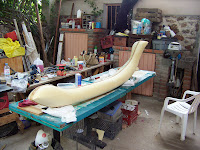


The next photo shows the fibreglass ( a single layer of matte) as it is cut and laid on before adding the resin. The fibreglass and resin are bonded to the foam and this forms the outer layer of the mould (middle picture). Then the foam is carefully cut away from the plywood spine.


After the foam is separated from the spine, it is mounted on a couple of posts, and wrapped with plastic film, of the type you wrap leftovers in. Now is it ready for the thick fibreglass layer: two layers of matte sandwiching a layer of woven roving. The fibreglass will not stick to the mould because of the layers of plastic film. You could use mould release wax, but I didn't have any.


Once I made the first fibreglass cast, I had to grind it off at the ends so it would open enough to remove it. Then I put it back in place and shipped it to Chetumal, near the border with Belize. There it would wait for me to carry it across the border.
Once I was in Belize, I took the bus up to the border and dropped in on my friends Rolando and Mercedes. They were storing it for me, and kindly took me in overnight. The next morning Rolando drove me to the border. I walked across the Rio Hondo bridge into Belize and went to Customs and Immigration. The Customs officers didnt know how much to rob me in duty for this strange-looking object. They base their "duty" on the market value, plus the cost of shipping and insuring the object. The shipping cost was typed on the waybill. It said $845. So they assumed that was in US dollars. I told them that was pesos (it was), and they finally believed me when I explained that the sign for pesos is not found on a keyboard, so they use the $ sign. So when they finally tallied up their estimate they charge 20%, then taxes on their fee (!). It all came to almost $100us. For a chunk of foam and fibreglass that I made myself. So I left the Customs office and started walking to Corozal, a distance of about 20 miles. Of course the second pickup truck that passed by stopped for me and I rode in the back until I saw the bus station. I was concerned about the awkwardness of taking the ama on the bus but it fit right under the seats – the buses here are all old Bluebird school buses, totally unmodified. The rest is uneventful.
When I got to Dangriga I moved into the new guides house. Every year it is a different place, because they only rent it for a few months and have to take what they can get. This year it is the top floor of a two-storey concrete house at the south edge of town, right up against the mangroves (and sandflies).

This isnt it. But it is our immediate neighbour to the west. This picture was taken from the roof, which is accessible and has a rail all around, as you will see.

The first picture is the Manatee on the roof before I got the sawhorses built. After the sawhorses were built, I began work on the daggerboard trunk. On the right you can see the opening in the hull for the daggerboard (a hinged keel: more like a jackknife than a dagger). In the centre picture the dagger board is barely visible sticking up through the opening. I like this picture because it shows how sleek this boat is.
On the left is a better view of the daggerboard, which is an old rudder salvaged off a wrecked Hobiecat, found out at Half Moon Caye. Above the boat is the framework for a shade. I only set the tarp up when I am going to work on the boat. Otherwise the wind beats it up and pulls the poles all apart.


The photo on the right shows the trunk: the box in which the dagger board is housed. Also evident in this picture are the two bulkheads with large hatches cut into them.
Just working on this section made me realise I am not getting this boat done this year; especially since I spent the bulk of my time off vacationing with Lorena, which I don’t regret in the least.
So thats my progress so far, folks. Next posting will come in a week or two. I have to rustle up some photos from some of my guests first. Cheers, Jack
The first three photos show the basic shape of an ama. It is made of polyisocyanurate foam (which is expensive but doesnt dissolve on contact with polyester resin like styrofoam would), cut with a saw and shaped with planing tools and coarse sandpaper. The foam is two sheets glued together and glued to a plywood backbone which was precut to the right shape, and gives a consistent form and stiffness to the mould. Without the plywood spine it never would have come out symmetrical.
The next photo shows the fibreglass ( a single layer of matte) as it is cut and laid on before adding the resin. The fibreglass and resin are bonded to the foam and this forms the outer layer of the mould (middle picture). Then the foam is carefully cut away from the plywood spine.
After the foam is separated from the spine, it is mounted on a couple of posts, and wrapped with plastic film, of the type you wrap leftovers in. Now is it ready for the thick fibreglass layer: two layers of matte sandwiching a layer of woven roving. The fibreglass will not stick to the mould because of the layers of plastic film. You could use mould release wax, but I didn't have any.
Once I made the first fibreglass cast, I had to grind it off at the ends so it would open enough to remove it. Then I put it back in place and shipped it to Chetumal, near the border with Belize. There it would wait for me to carry it across the border.
Once I was in Belize, I took the bus up to the border and dropped in on my friends Rolando and Mercedes. They were storing it for me, and kindly took me in overnight. The next morning Rolando drove me to the border. I walked across the Rio Hondo bridge into Belize and went to Customs and Immigration. The Customs officers didnt know how much to rob me in duty for this strange-looking object. They base their "duty" on the market value, plus the cost of shipping and insuring the object. The shipping cost was typed on the waybill. It said $845. So they assumed that was in US dollars. I told them that was pesos (it was), and they finally believed me when I explained that the sign for pesos is not found on a keyboard, so they use the $ sign. So when they finally tallied up their estimate they charge 20%, then taxes on their fee (!). It all came to almost $100us. For a chunk of foam and fibreglass that I made myself. So I left the Customs office and started walking to Corozal, a distance of about 20 miles. Of course the second pickup truck that passed by stopped for me and I rode in the back until I saw the bus station. I was concerned about the awkwardness of taking the ama on the bus but it fit right under the seats – the buses here are all old Bluebird school buses, totally unmodified. The rest is uneventful.
When I got to Dangriga I moved into the new guides house. Every year it is a different place, because they only rent it for a few months and have to take what they can get. This year it is the top floor of a two-storey concrete house at the south edge of town, right up against the mangroves (and sandflies).
This isnt it. But it is our immediate neighbour to the west. This picture was taken from the roof, which is accessible and has a rail all around, as you will see.
The first picture is the Manatee on the roof before I got the sawhorses built. After the sawhorses were built, I began work on the daggerboard trunk. On the right you can see the opening in the hull for the daggerboard (a hinged keel: more like a jackknife than a dagger). In the centre picture the dagger board is barely visible sticking up through the opening. I like this picture because it shows how sleek this boat is.
On the left is a better view of the daggerboard, which is an old rudder salvaged off a wrecked Hobiecat, found out at Half Moon Caye. Above the boat is the framework for a shade. I only set the tarp up when I am going to work on the boat. Otherwise the wind beats it up and pulls the poles all apart.
The photo on the right shows the trunk: the box in which the dagger board is housed. Also evident in this picture are the two bulkheads with large hatches cut into them.
Just working on this section made me realise I am not getting this boat done this year; especially since I spent the bulk of my time off vacationing with Lorena, which I don’t regret in the least.
So thats my progress so far, folks. Next posting will come in a week or two. I have to rustle up some photos from some of my guests first. Cheers, Jack
Sunday, June 08, 2008
How can one describe silence? How can one share solitude? How can a desire for aloneness cure a loneliness of the soul? That is the rub, isn’t it? The paradox of wilderness. We want it , indeed need wilderness to exist, even if we never set foot in it. Many insist that there be places on this earth where no human treads, even lightly. I am one such person. But I am selfish. I also need places where no permanent trace of man exists, and yet I want to be there. To live, even briefly, as man lived before civilisation, before industrialisation, before globalisation. To breathe the silence, to drink in the emptiness, to swell inside with the fullness of a lonely planet, empty of my own kind.
I can only speak for myself. When I leave behind humanity and enter the wild world, it takes about three days before the voice in my head quiets. Suddenly I am truly present in my surroundings, no longer buffered and shielded by the continuous chatter that substitutes for my own thoughts. Thinking, feeling and being, are revealed to be three different processes of mind. It takes continuous silence, not from sound, but from noise,the kind you are trained since birth to notice, to interpret. Voices, street traffic, music, commercials. And noise, which comes in a visual form as well, especially if written in billboards ten feet high, demands your attention even if you don’t realise it. And by grabbing and holding your attention, noise, in all its forms, robs you of your presence of mind; that is, it takes you out of yourself, and prevents your self from being present, in the moment, and connected to all things.
In the bush, in the desert, on the sea, your attention is also needed, but the volume of traffic on your brain is much slower, more manageable, and devoid of any social context. The word peaceful springs to mind. There is a peace in solitude that cannot exist in the presence of another human being. But how can one describe this kind of peace, with the words that shatter it, deny its existence? How can one hope to communicate the feeling of that moment, when all internal communication stops, ceases to exist, and all that is is a state of peaceful emptiness of mind, of a fullness of spirit, a moment of mere, bare , pure existence? Alone, but not lonely, indeed the opposite of lonely, in which the connectedness of all the universe is known without thought, felt without sensation, but just is.
I can only speak for myself. When I leave behind humanity and enter the wild world, it takes about three days before the voice in my head quiets. Suddenly I am truly present in my surroundings, no longer buffered and shielded by the continuous chatter that substitutes for my own thoughts. Thinking, feeling and being, are revealed to be three different processes of mind. It takes continuous silence, not from sound, but from noise,the kind you are trained since birth to notice, to interpret. Voices, street traffic, music, commercials. And noise, which comes in a visual form as well, especially if written in billboards ten feet high, demands your attention even if you don’t realise it. And by grabbing and holding your attention, noise, in all its forms, robs you of your presence of mind; that is, it takes you out of yourself, and prevents your self from being present, in the moment, and connected to all things.
In the bush, in the desert, on the sea, your attention is also needed, but the volume of traffic on your brain is much slower, more manageable, and devoid of any social context. The word peaceful springs to mind. There is a peace in solitude that cannot exist in the presence of another human being. But how can one describe this kind of peace, with the words that shatter it, deny its existence? How can one hope to communicate the feeling of that moment, when all internal communication stops, ceases to exist, and all that is is a state of peaceful emptiness of mind, of a fullness of spirit, a moment of mere, bare , pure existence? Alone, but not lonely, indeed the opposite of lonely, in which the connectedness of all the universe is known without thought, felt without sensation, but just is.
Tuesday, April 29, 2008
The longest stage of any journey begins when you start to see signs you are almost home.
It is said that “Life is a journey”. We focus too much on the little destinations, the goals that have been set before us, so that we do not live in the moment but are always striving for a distant future. But the destinations are but instants in time: they occupy none of the space of our lives. It is the striving, the journey itself that fills the space between the destinations: this is where we live.
It’s hard to feel that way when you are travelling home. Heading away from home is a form of exploration. Every moment has meaning because travel is the purpose of your life at that moment. But when you set your sights on home you cease to travel, as an activity, as a form of exploration. From then on all the experiences of your travel are an annoyance, something that stands between you and your goal. The goal isn’t to go home: it is to be home.
That was how I felt at the end of my season in Belize this year. Don’t get me wrong: it was a good season for me. I met some very interesting people, and had a great time swimming with the fishies. But once the season was over, I was in a hurry to get home, to be there on my birthday, with Lorena. And a cancelled flight meant I had to get from Dangriga to Cancun overland in a single day. Now I am home, in San Carlos, in late April. The days are warm, the nights are cool and the air is dry. And the sea is chilly. Oh well, I can go a while without snorkelling with no ill effects.
This blog is supposed to be about the Manatee. Well the first one is gone, and the second one is under construction. It has been a great experience working on the new boat this past winter. I had done a little fibreglass work before, but never actually built anything out of fibreglass. This year, with the help of Kerry (aka Bobo), Island Expeditions’ resident fibreglass expert, I have built the decking, the cockpit, bulkheads, hatches and the centreboard trunk, all out of fibreglass. When she is done, she will be all fibreglass except the floor and a folding table attached to the centreboard trunk.
I was planning to photodocument each stage of the process, but I left my camera in San Carlos and took only one photo of the boat with the camera of another guide. So the pictures will have to wait. Now I am home I plan to build the amas (outriggers) and akas (crossbeams between the amas and the main hull) here in San Carlos, and ship them to Belize for the beginning of next season. This gives me plenty of time to work on them. Next season I should be able to assemble the whole boat before I start work and then take her out with me. I will sail her around and find her weaknesses before I set out on my voyage home. This next one will have two amas, so if one fails, I have a backup until I can get it fixed. It will also be very fast as it is longer - 20 ft - and lighter - about 1/3 the weight of the first one. The further I progress, the more excited I become about the voyage home. Sometimes it is an obsession and I have to remind myself to enjoy the anticipation but live my life now. That said, it doesn’t mean I can’t reminisce. So I would like to share some of the moments I experienced this past field season in Belize.
We don’t often snorkel the Western Wall at Glover’s Reef, as it is too far to paddle for most groups, and the groups are usually too big to take the skiff. But this year the number of people travelling to Belize was way down, so we had some small groups. One such trip we decided to skiff over to the Western Wall and snorkel along the outside edge of the atoll where the bottom drops vertically to great depths. The wall is actually a series of walls, separated by ledges. We were snorkelling over one such ledge, with about 20 feet between us and the corals below. We saw the usual assortment of reef fishes, and in small sandy clearing lay a dead squirrelfish. We noted the fish and carried on when someone spotted a large green moray eel, swimming along the bottom in broad daylight. This is unusual, so we followed it as it poked its head in and out of various holes in the reef, until it came upon the dead squirrelfish. It must have caught scent of the fish and come looking for it. We watched as the huge eel writhed and struggled to swallow this spiny fish. The whole effort looked painful.
After the show was over, we spread out and continued to drift southward with the current. I was off to the right of the main group, right near the dropoff, when a large shape directly below caught my eye. My breath caught in my throat as a 12 ft. hammerhead shark swam steadily beneath me. This was the first time I had seen a shark that could easily eat me, while I was in the water with it. The long, lithe body and powerful tail contrasted sharply with the more commonly seen nurse shark. I had a feeling, looking at this fellow, that he could easily turn and take a monstrous bite out of me should he decide to. Rationally I knew I had nothing to fear, as shark attacks are almost always on people who are spearfishing, and the shark really just wants the fish. I also quickly surmised that he wasn’t interested in us because he was already past us and swimming determinedly southward. I tried to follow, but even though he wasn’t in a hurry, he was still far too fast to keep up with. But just for the briefest of moments, he was Jaws, and I was one of his hapless victims.
My second shark encounter was much closer and much, much scarier. I was snorkelling a new patch reef, near the edge of the atoll at Lighthouse Reef, with two guests in tow. We had anchored in about 15 ft. of water, and were working our way around this big patch reef. As we got nearer to the edge of the reef, the patch reef broke up into a series of large dead coral mounds. I got an eerie feeling there. There was no live coral, no fish even. As I rounded one mound, I suddenly saw a big, heavy-bodied shark, swimming away from me, scanning back and forth. Usually when you see a shark during the day, they are milling around, killing time. This one looked like it was looking for something. I turned and looked for my friends. Then I stuck my head back in the water. The shark emerged again, a few feet away. This time he had a school of jacks with him. They knew he was hunting. Again he swam away.
I pressed myself against the coral head and looked for my guests again. I called them over and said “Snorkel’s over. I just saw a really big shark.” Read the italics as a kind of breathy speech. “Ok,” I continued, “Let’s swim over to the boats together, like one big fish.” No one argued or questioned me and we more or less did just that. It seemed to take forever for the two of them to get into the boats, as I stayed under, scanning the water. Then we were all in and on our way back. When the fear is over, you are left with a rush of adrenaline, the kind of high that makes you feel truly and sharply alive. You feel like you are charged with electricity, covered in Saint Elmo's fire. There is nothing like it.
It occurred to me that if one of the Belizian guides was with us, I wouldn’t have felt so spooked. These guys know the sea, they live in these waters, and I rely on them for their knowledge and experience. But when it is all up to me, I don’t quite have the same confidence, not when other peoples’ lives are at stake. Later conversations with Alex, the most experienced of the Belizian guides, convinced me it was probably a bull shark, and that it was wise to get out of the water when we did.
I guess that’s a part of life, isn’t it? Knowing when to get out of the water. That’s my cue.
Cheers
Island Jack
It is said that “Life is a journey”. We focus too much on the little destinations, the goals that have been set before us, so that we do not live in the moment but are always striving for a distant future. But the destinations are but instants in time: they occupy none of the space of our lives. It is the striving, the journey itself that fills the space between the destinations: this is where we live.
It’s hard to feel that way when you are travelling home. Heading away from home is a form of exploration. Every moment has meaning because travel is the purpose of your life at that moment. But when you set your sights on home you cease to travel, as an activity, as a form of exploration. From then on all the experiences of your travel are an annoyance, something that stands between you and your goal. The goal isn’t to go home: it is to be home.
That was how I felt at the end of my season in Belize this year. Don’t get me wrong: it was a good season for me. I met some very interesting people, and had a great time swimming with the fishies. But once the season was over, I was in a hurry to get home, to be there on my birthday, with Lorena. And a cancelled flight meant I had to get from Dangriga to Cancun overland in a single day. Now I am home, in San Carlos, in late April. The days are warm, the nights are cool and the air is dry. And the sea is chilly. Oh well, I can go a while without snorkelling with no ill effects.
This blog is supposed to be about the Manatee. Well the first one is gone, and the second one is under construction. It has been a great experience working on the new boat this past winter. I had done a little fibreglass work before, but never actually built anything out of fibreglass. This year, with the help of Kerry (aka Bobo), Island Expeditions’ resident fibreglass expert, I have built the decking, the cockpit, bulkheads, hatches and the centreboard trunk, all out of fibreglass. When she is done, she will be all fibreglass except the floor and a folding table attached to the centreboard trunk.
I was planning to photodocument each stage of the process, but I left my camera in San Carlos and took only one photo of the boat with the camera of another guide. So the pictures will have to wait. Now I am home I plan to build the amas (outriggers) and akas (crossbeams between the amas and the main hull) here in San Carlos, and ship them to Belize for the beginning of next season. This gives me plenty of time to work on them. Next season I should be able to assemble the whole boat before I start work and then take her out with me. I will sail her around and find her weaknesses before I set out on my voyage home. This next one will have two amas, so if one fails, I have a backup until I can get it fixed. It will also be very fast as it is longer - 20 ft - and lighter - about 1/3 the weight of the first one. The further I progress, the more excited I become about the voyage home. Sometimes it is an obsession and I have to remind myself to enjoy the anticipation but live my life now. That said, it doesn’t mean I can’t reminisce. So I would like to share some of the moments I experienced this past field season in Belize.
We don’t often snorkel the Western Wall at Glover’s Reef, as it is too far to paddle for most groups, and the groups are usually too big to take the skiff. But this year the number of people travelling to Belize was way down, so we had some small groups. One such trip we decided to skiff over to the Western Wall and snorkel along the outside edge of the atoll where the bottom drops vertically to great depths. The wall is actually a series of walls, separated by ledges. We were snorkelling over one such ledge, with about 20 feet between us and the corals below. We saw the usual assortment of reef fishes, and in small sandy clearing lay a dead squirrelfish. We noted the fish and carried on when someone spotted a large green moray eel, swimming along the bottom in broad daylight. This is unusual, so we followed it as it poked its head in and out of various holes in the reef, until it came upon the dead squirrelfish. It must have caught scent of the fish and come looking for it. We watched as the huge eel writhed and struggled to swallow this spiny fish. The whole effort looked painful.
After the show was over, we spread out and continued to drift southward with the current. I was off to the right of the main group, right near the dropoff, when a large shape directly below caught my eye. My breath caught in my throat as a 12 ft. hammerhead shark swam steadily beneath me. This was the first time I had seen a shark that could easily eat me, while I was in the water with it. The long, lithe body and powerful tail contrasted sharply with the more commonly seen nurse shark. I had a feeling, looking at this fellow, that he could easily turn and take a monstrous bite out of me should he decide to. Rationally I knew I had nothing to fear, as shark attacks are almost always on people who are spearfishing, and the shark really just wants the fish. I also quickly surmised that he wasn’t interested in us because he was already past us and swimming determinedly southward. I tried to follow, but even though he wasn’t in a hurry, he was still far too fast to keep up with. But just for the briefest of moments, he was Jaws, and I was one of his hapless victims.
My second shark encounter was much closer and much, much scarier. I was snorkelling a new patch reef, near the edge of the atoll at Lighthouse Reef, with two guests in tow. We had anchored in about 15 ft. of water, and were working our way around this big patch reef. As we got nearer to the edge of the reef, the patch reef broke up into a series of large dead coral mounds. I got an eerie feeling there. There was no live coral, no fish even. As I rounded one mound, I suddenly saw a big, heavy-bodied shark, swimming away from me, scanning back and forth. Usually when you see a shark during the day, they are milling around, killing time. This one looked like it was looking for something. I turned and looked for my friends. Then I stuck my head back in the water. The shark emerged again, a few feet away. This time he had a school of jacks with him. They knew he was hunting. Again he swam away.
I pressed myself against the coral head and looked for my guests again. I called them over and said “Snorkel’s over. I just saw a really big shark.” Read the italics as a kind of breathy speech. “Ok,” I continued, “Let’s swim over to the boats together, like one big fish.” No one argued or questioned me and we more or less did just that. It seemed to take forever for the two of them to get into the boats, as I stayed under, scanning the water. Then we were all in and on our way back. When the fear is over, you are left with a rush of adrenaline, the kind of high that makes you feel truly and sharply alive. You feel like you are charged with electricity, covered in Saint Elmo's fire. There is nothing like it.
It occurred to me that if one of the Belizian guides was with us, I wouldn’t have felt so spooked. These guys know the sea, they live in these waters, and I rely on them for their knowledge and experience. But when it is all up to me, I don’t quite have the same confidence, not when other peoples’ lives are at stake. Later conversations with Alex, the most experienced of the Belizian guides, convinced me it was probably a bull shark, and that it was wise to get out of the water when we did.
I guess that’s a part of life, isn’t it? Knowing when to get out of the water. That’s my cue.
Cheers
Island Jack
Friday, February 01, 2008
Back in Belize, with high hopes and empty pockets. Came early intending to work on the new Manadi, but can't do any work until I gt some money, so I am enjoying playing tourist. Went camping for ten with a friend from Tucson. Here are some highlights...
Sailing a double kayak in a lovely NE breeze, we spy a dolphin clearing the water about 100m ahead. So I scratch the hull of the kayak to get his attention. and soon he appears below us in the clear green water. He swims alongside, underneath us for a few seconds, then crosses under us and disappears. We take this as an auspicious start to our trip.
Day 3 Tobacco Range. A cold front has come in and strong NW winds are keeping us on the beach. A fishing boat from the north coast is using our island as shelter from the wind, so the crew come ashore. The Skipper teaches me how to weave a net. We use his net needle and I make a net bag. This is a great skill to have. Later we get some bamboo and carve net needles. Several of us are at work carving these needles, and one suggests a contest to see who can make the nicest one. I have the sharpest knife and so win the contest, not by any skill of my own.
Day 6: We are entering Sittee River after crossing several miles from Billyhawk Cay. Right at the mouth are three manatees, which we watch only briefly before they spot us and disappear. We enter the river, and about a mile in there is a narrow side channel which connects to a lagoon. We pass into the channel and are swallowed up by the forest. The scene about us is magical. We are surrounding by tall tangles of mangrove roots, and enclosed by the forest. Tiny birds flit by so swiftly we can't identify them, and all is still and silent. The silence rings in our ears after so many days of constant wind and waves. We drift with the current and marvel at our surroundings before we burst forth into a large round lagoon and the spell is broken.
Day 7: We are camped on a beautiful sandy beach, with our own dock and picnic area. Through the sparse woods behind us is a lagoon, and a new-built road. In the bush we find a pair of narrow-gauge locomotive wheels, and there is evidence of dredging in the lagoon. We later discover that there is a big marina and housing devlopment planned for this area, but for now we have it to ourselves. Ourselves and millions of nasty biting sandflies. For now the breeze is blowing and we are content to hang our hammocks and make our dinner in peace. But in the morning, after a rain followed by a windless day, we are driven away as fast as we can flee.
Day 9: We are on the Sittee River, at the Riverview Lodge, which for now is just a restaurant and dock, but we are very pleased with the people and the location. We have slung our hammocks under a big thatch, and we have a place to cook our meals and hang our clothes, along with a shower and toilets. This place is perfect for us. The owners are friendly and helpful and plan to build some cabins on the grounds. And camping is only $10 BZE ($5US) per night.
From the dock we watch tiger herons and little blue herons stalk the shoreline. A small black opossum steals by in the night. He is headed to a small channel to drink where he is reasonably safe from crocodiles. Later we see one glide by, about a 10-footer.
In the trees around our campsite we see and hear oropendulas, melodious blackbirds, red-lored parrots, a huge, orange and black iguana, and two keel-billed toucans. The toucans are a real highlight, being such an unusual bird and are a big attraction to the Sittee River area.
We get a couple of bikes and ride up the road, looking for the old sugar mill. A Salvadorian citrus worker helps us find it, and we discover huge wheels and gears buried in the jungle vegetation. By the size of the trees that have grown up in this site, it has been abandoned for a long time. We later learn it was the first sugar mill in Belize, built in the 1830's. We also learn that from here was built a railway to take the sugar to the sea, where it was loaded on schooners. The point of loading was that very beach where we had camped among the locomotive wheels and sandflies. Another mystery solved and a trip worth the effort.
A word about campsites. Much of the coast of this tiny country is privately owned, but we found welcoming people and affordable sites. One such place is Billyhawk Cay, which has a small fledgling resort. For $10bze a night you can camp there and live among Garifuna fishermen. If you don't catch any fish, they will sell you some, and there are nice coral reefs nearby to explore. They also have small rooms available and a bar.
Another spot we found was Castillo's Beach, on the north end of Hopkins. Mr. Castillo let us stay on his beach for $10 bze for the both of us. The beach is very nice for swimming, there is a picnic table and flat ground for a tent or some nice tres to sling a jungle hammock. He also let us use his shower and toilet, in an outbuilding near his house. Right beside his house is Sew Much Hemp, where you can buy natural insect repellent and a variety of hemp-based clothing and other products (not weed). I didn't try the insect repellent, but it sure smells better than DEET.
The last day was a 14 mile paddle from Sittee River to Dangriga against the wind. It was a long day but we enjoyed the challenge and certainly felt we had earned a cold Belikin beer at the end of that day.
See you soon. Cheers
Jack
Sailing a double kayak in a lovely NE breeze, we spy a dolphin clearing the water about 100m ahead. So I scratch the hull of the kayak to get his attention. and soon he appears below us in the clear green water. He swims alongside, underneath us for a few seconds, then crosses under us and disappears. We take this as an auspicious start to our trip.
Day 3 Tobacco Range. A cold front has come in and strong NW winds are keeping us on the beach. A fishing boat from the north coast is using our island as shelter from the wind, so the crew come ashore. The Skipper teaches me how to weave a net. We use his net needle and I make a net bag. This is a great skill to have. Later we get some bamboo and carve net needles. Several of us are at work carving these needles, and one suggests a contest to see who can make the nicest one. I have the sharpest knife and so win the contest, not by any skill of my own.
Day 6: We are entering Sittee River after crossing several miles from Billyhawk Cay. Right at the mouth are three manatees, which we watch only briefly before they spot us and disappear. We enter the river, and about a mile in there is a narrow side channel which connects to a lagoon. We pass into the channel and are swallowed up by the forest. The scene about us is magical. We are surrounding by tall tangles of mangrove roots, and enclosed by the forest. Tiny birds flit by so swiftly we can't identify them, and all is still and silent. The silence rings in our ears after so many days of constant wind and waves. We drift with the current and marvel at our surroundings before we burst forth into a large round lagoon and the spell is broken.
Day 7: We are camped on a beautiful sandy beach, with our own dock and picnic area. Through the sparse woods behind us is a lagoon, and a new-built road. In the bush we find a pair of narrow-gauge locomotive wheels, and there is evidence of dredging in the lagoon. We later discover that there is a big marina and housing devlopment planned for this area, but for now we have it to ourselves. Ourselves and millions of nasty biting sandflies. For now the breeze is blowing and we are content to hang our hammocks and make our dinner in peace. But in the morning, after a rain followed by a windless day, we are driven away as fast as we can flee.
Day 9: We are on the Sittee River, at the Riverview Lodge, which for now is just a restaurant and dock, but we are very pleased with the people and the location. We have slung our hammocks under a big thatch, and we have a place to cook our meals and hang our clothes, along with a shower and toilets. This place is perfect for us. The owners are friendly and helpful and plan to build some cabins on the grounds. And camping is only $10 BZE ($5US) per night.
From the dock we watch tiger herons and little blue herons stalk the shoreline. A small black opossum steals by in the night. He is headed to a small channel to drink where he is reasonably safe from crocodiles. Later we see one glide by, about a 10-footer.
In the trees around our campsite we see and hear oropendulas, melodious blackbirds, red-lored parrots, a huge, orange and black iguana, and two keel-billed toucans. The toucans are a real highlight, being such an unusual bird and are a big attraction to the Sittee River area.
We get a couple of bikes and ride up the road, looking for the old sugar mill. A Salvadorian citrus worker helps us find it, and we discover huge wheels and gears buried in the jungle vegetation. By the size of the trees that have grown up in this site, it has been abandoned for a long time. We later learn it was the first sugar mill in Belize, built in the 1830's. We also learn that from here was built a railway to take the sugar to the sea, where it was loaded on schooners. The point of loading was that very beach where we had camped among the locomotive wheels and sandflies. Another mystery solved and a trip worth the effort.
A word about campsites. Much of the coast of this tiny country is privately owned, but we found welcoming people and affordable sites. One such place is Billyhawk Cay, which has a small fledgling resort. For $10bze a night you can camp there and live among Garifuna fishermen. If you don't catch any fish, they will sell you some, and there are nice coral reefs nearby to explore. They also have small rooms available and a bar.
Another spot we found was Castillo's Beach, on the north end of Hopkins. Mr. Castillo let us stay on his beach for $10 bze for the both of us. The beach is very nice for swimming, there is a picnic table and flat ground for a tent or some nice tres to sling a jungle hammock. He also let us use his shower and toilet, in an outbuilding near his house. Right beside his house is Sew Much Hemp, where you can buy natural insect repellent and a variety of hemp-based clothing and other products (not weed). I didn't try the insect repellent, but it sure smells better than DEET.
The last day was a 14 mile paddle from Sittee River to Dangriga against the wind. It was a long day but we enjoyed the challenge and certainly felt we had earned a cold Belikin beer at the end of that day.
See you soon. Cheers
Jack
Wednesday, September 19, 2007
I'm back in San Carlos, just after a grazing by Tropical Storm Henriette. we got some wind, much rain, and very little damage.
I recently got a request for more desert photos, so i am dedicating this post to the beautiful Sonoran Desert. Those among you who are more interested in the marine stuff, skip this one but don't give up on me. Soon I will begin construction on the new amas (outriggers)for the Manatee.
San Carlos is in the southern Sonoran desert, in a region of the desert known as the Central Gulf Coast region. Rains here come mostly in the summer. The winter rains which are fairly reliable in the north, particularly around Tucson, Arizona, may not fall here for several years. Despite this, the desert is surprisingly shrubby.
Surprising too, is how dry it can be a few feet from the sea. All that moisture, and it hardly falls on land. This is typical of deserts found in the "Horse Latitudes". The horse latitudes (roughly 30 degrees, north and south of the equator)are a region of descending air, which as it falls, warms and dries. The result is very stable air, with few clouds, little wind, and very little precipitation. And the ability to tie your boat to a cactus.
Much of the Sonoran Desert is in the Basin and Range Province of southwestern North America. Small ranges of moderate to low volcanic mountains rise through a flat basin of volcanic dust and ash. San Carlos is on the seaward edge of the Sierra el Aguaje, a mountain range split with canyons and pushed right up to the sea. The canyons are shady and often have water seeping in from the surrounding porous rock. As a result these canyons often harbour a variety of tropical deciduous forest species, normally found hundreds of kilometres to the south. On the slopes are more typical desert species, such as cacti and agave plants.
Even talk. The pictures were chosen to show the variety of landforms and vegetation. I hope you enjoy them.
Cheers,
Jack


I recently got a request for more desert photos, so i am dedicating this post to the beautiful Sonoran Desert. Those among you who are more interested in the marine stuff, skip this one but don't give up on me. Soon I will begin construction on the new amas (outriggers)for the Manatee.
San Carlos is in the southern Sonoran desert, in a region of the desert known as the Central Gulf Coast region. Rains here come mostly in the summer. The winter rains which are fairly reliable in the north, particularly around Tucson, Arizona, may not fall here for several years. Despite this, the desert is surprisingly shrubby.
Surprising too, is how dry it can be a few feet from the sea. All that moisture, and it hardly falls on land. This is typical of deserts found in the "Horse Latitudes". The horse latitudes (roughly 30 degrees, north and south of the equator)are a region of descending air, which as it falls, warms and dries. The result is very stable air, with few clouds, little wind, and very little precipitation. And the ability to tie your boat to a cactus.
Much of the Sonoran Desert is in the Basin and Range Province of southwestern North America. Small ranges of moderate to low volcanic mountains rise through a flat basin of volcanic dust and ash. San Carlos is on the seaward edge of the Sierra el Aguaje, a mountain range split with canyons and pushed right up to the sea. The canyons are shady and often have water seeping in from the surrounding porous rock. As a result these canyons often harbour a variety of tropical deciduous forest species, normally found hundreds of kilometres to the south. On the slopes are more typical desert species, such as cacti and agave plants.
Even talk. The pictures were chosen to show the variety of landforms and vegetation. I hope you enjoy them.
Cheers,
Jack


Monday, September 17, 2007
I’ve been asked to post more frequently and more regularly, lest my readers lose interest. My philosophy has been to post when I think I have something interesting to say, however rare and random that may be. Please let me know what you think.
Lorena and I are at the cottage, on the shore of Lake Talon; a lake in Northern Ontario. The water is a light tea colour, tinted by the water from the bogs in its catchment area. By mid-August it is already chilly for swimming, and so our daily bath is quick and bracing, but necessary, as there is no indoor plumbing this year.
I awoke last night, for the usual reasons, and peering out through the big front windows, I was struck by a rare and beautiful sight. In the bright moonlight a shroud of silver mist swirled slowly over the still, dark water in little peaks, like ghosts figure-skating in slow-motion over black ice. The nocturnal world seemed filled with magic, and I could only stand and stare in wonder. At such moments, you forget about the cold, and the flies, and all the inconveniences of living in such a place, and are only grateful for the brief moments of awe and wonder. Like the lonely call of a loon, drifting in through the fog, or when a bright green dragonfly with crimson eyes comes to rest on your shoulder as you paddle among the reeds and water-lilies, and you know no deerfly will dare approach to bite your neck. Or the sudden slap of a beaver’s tail, warning his neighbours of your approach as you round a bend in the river. Or the immense silence of a windless day, occasionally broken by the chattering of a red squirrel, or the distant drumming of a grouse. These are the moments that, put together, make life in the bush so rewarding in a way that is difficult to describe to one who has not experienced it for himself. And they are the moments that come back to you in sudden flashes, when you are thousands of miles away, and make you suddenly long for home, for the smell of pine and woodsmoke, for the soft rustle of leaves underfoot, for the immense silence of new-fallen snow.
Meanwhile, hurricane Henriette has hit San Carlos, and we have to wait to assess the damages. First reports are good; it was brief and not too intense. So we are expecting minimal damage. I’ll keep you posted.
Cheers
Jack
Lorena and I are at the cottage, on the shore of Lake Talon; a lake in Northern Ontario. The water is a light tea colour, tinted by the water from the bogs in its catchment area. By mid-August it is already chilly for swimming, and so our daily bath is quick and bracing, but necessary, as there is no indoor plumbing this year.
I awoke last night, for the usual reasons, and peering out through the big front windows, I was struck by a rare and beautiful sight. In the bright moonlight a shroud of silver mist swirled slowly over the still, dark water in little peaks, like ghosts figure-skating in slow-motion over black ice. The nocturnal world seemed filled with magic, and I could only stand and stare in wonder. At such moments, you forget about the cold, and the flies, and all the inconveniences of living in such a place, and are only grateful for the brief moments of awe and wonder. Like the lonely call of a loon, drifting in through the fog, or when a bright green dragonfly with crimson eyes comes to rest on your shoulder as you paddle among the reeds and water-lilies, and you know no deerfly will dare approach to bite your neck. Or the sudden slap of a beaver’s tail, warning his neighbours of your approach as you round a bend in the river. Or the immense silence of a windless day, occasionally broken by the chattering of a red squirrel, or the distant drumming of a grouse. These are the moments that, put together, make life in the bush so rewarding in a way that is difficult to describe to one who has not experienced it for himself. And they are the moments that come back to you in sudden flashes, when you are thousands of miles away, and make you suddenly long for home, for the smell of pine and woodsmoke, for the soft rustle of leaves underfoot, for the immense silence of new-fallen snow.
Meanwhile, hurricane Henriette has hit San Carlos, and we have to wait to assess the damages. First reports are good; it was brief and not too intense. So we are expecting minimal damage. I’ll keep you posted.
Cheers
Jack
Monday, July 16, 2007
Desert Thirst

I had a writer here for a few days. His name is Roland Pelletier, and he is writing a book that takes place in Guaymas in the 1850’s and wanted someone to take him around the city and into the desert. It seemed an easy assignment.
I took him for a hike in the desert. Ordinarily we don’t hike in the desert at this time of year; it was 107F or 42C today (the day I am writing this), at noon. But this was when he came, so off we went. It was a typical summer day; a cloudless sky of rich blue, like looking up at the Caribbean. We walked over some rolling hills and open country at first. The desert is very dry; months without rain have taken every leaf from the shrubs and trees, leaving a brown and grey landscape. The only green is the odd organpipe cactus, scattered along the hillsides, and the dense thornscrub in the deeper washes, where water is available year-round. Two deer bounded into a draw as we crossed over a hill. I wondered what they found to eat. We crossed a wash and strolled over the open ground beyond. Then we descended back into the wash, at first struggling through the dense bush. Eventually the wash narrowed into a boulder-strewn canyon, with palm trees that rustle in the breeze like flowing water, high walls of worn tuff, riddled with caves. After reaching a blind end at a 20 ft waterfall (dry of course), we decided to back out a bit and then climb the side, to get around the barrier. That’s when the trouble started.
The rock here is rotten, soft and easily broken; a perfect handhold may crumble with a light tug. We ascended the near-vertical sides without incident, but there was no going back the way we came up. The rest was a safer slope, but much of it was loose scree and treacherous enough with good hikers underfoot. And my friend Roland was wearing boots with smooth soles. At least they were rubber, not leather, so they held well onto hard rock. But it was treacherous going. We got to the top, and the other side was a long, vertical drop. We tried to find another way into the canyon we left, but it ended in the same, vertical formations. So the only way was to move laterally, and get ahead of the dry waterfall. This choice was the safer one, but we were already almost out of water. And to carry on meant heading a long, roundabout route through desert wash and dense thornscrub bush.
So we headed on. The sun was hot, the air hot, heavy, and still. Walking under the sun was like carrying a hot stone on your back and shoulders. My water was long gone, (I had only brought 3 litres for the two of us, planning on an hour or two on easy ground), and the thirst was intense. Saliva becomes thick, like glue, or a MacDonald’s shake, and the eyes become dry and uncomfortable. On we trudged, over boulders, through brush, out into the open where the mountains dip down to make a notch. Through this notch we descended into another wash, thick with scratchy, thorny and prickly brush. By this time we walked in silence, automatically moving forward, pushing through thickets, crunching over loose gravel, moving onward, forward, towards water, life and relief from the awful thirst. By the time we reached the last section of our hike, a dirt road over even ground, Roland turned to me and said “My hands are swollen.” I looked at mine and realized the same thing was happening to me. He also asked me if I could feel my heart pounding in my chest. Fortunately I couldn’t, and we knew we would be okay soon, so we became more relaxed, and began to talk again.

Roland wanted an experience of the desert and he got one. It is important to realize that the desert is not malevolently waiting for you to make a mistake so it can punish you. It is merciless, not because it is evil, but because it is indifferent. Man does not struggle against nature; he struggles against his own fragility, his own limitations, with nature not as his opponent, but as an impartial and disinterested judge. To survive here, you need to know what you need and how to get it. And if you don’t have what you need to survive here, you had better stay on the cilivised side of the edge.
People rarely die way out in the wilderness, far from help, out of communication range. The only people who get that far are those who know what they are doing. People more often die on the edges, near to civilization. Unprepared, unequipped, and caught off guard, they wander lost, or simply get themselves stuck somewhere and perish before they can get back out. We won that particular race, but it could have gone the other way if we were forced, say, to spend the night, or if an accident or injury befell one of us and slowed us down too much. And remember, long before you die from environmental exposure, your judgment becomes impaired, and you make foolish decisions which make your situation worse. So to survive you need enough to keep from getting that far, to the point of no return.

I had a writer here for a few days. His name is Roland Pelletier, and he is writing a book that takes place in Guaymas in the 1850’s and wanted someone to take him around the city and into the desert. It seemed an easy assignment.
I took him for a hike in the desert. Ordinarily we don’t hike in the desert at this time of year; it was 107F or 42C today (the day I am writing this), at noon. But this was when he came, so off we went. It was a typical summer day; a cloudless sky of rich blue, like looking up at the Caribbean. We walked over some rolling hills and open country at first. The desert is very dry; months without rain have taken every leaf from the shrubs and trees, leaving a brown and grey landscape. The only green is the odd organpipe cactus, scattered along the hillsides, and the dense thornscrub in the deeper washes, where water is available year-round. Two deer bounded into a draw as we crossed over a hill. I wondered what they found to eat. We crossed a wash and strolled over the open ground beyond. Then we descended back into the wash, at first struggling through the dense bush. Eventually the wash narrowed into a boulder-strewn canyon, with palm trees that rustle in the breeze like flowing water, high walls of worn tuff, riddled with caves. After reaching a blind end at a 20 ft waterfall (dry of course), we decided to back out a bit and then climb the side, to get around the barrier. That’s when the trouble started.
The rock here is rotten, soft and easily broken; a perfect handhold may crumble with a light tug. We ascended the near-vertical sides without incident, but there was no going back the way we came up. The rest was a safer slope, but much of it was loose scree and treacherous enough with good hikers underfoot. And my friend Roland was wearing boots with smooth soles. At least they were rubber, not leather, so they held well onto hard rock. But it was treacherous going. We got to the top, and the other side was a long, vertical drop. We tried to find another way into the canyon we left, but it ended in the same, vertical formations. So the only way was to move laterally, and get ahead of the dry waterfall. This choice was the safer one, but we were already almost out of water. And to carry on meant heading a long, roundabout route through desert wash and dense thornscrub bush.
So we headed on. The sun was hot, the air hot, heavy, and still. Walking under the sun was like carrying a hot stone on your back and shoulders. My water was long gone, (I had only brought 3 litres for the two of us, planning on an hour or two on easy ground), and the thirst was intense. Saliva becomes thick, like glue, or a MacDonald’s shake, and the eyes become dry and uncomfortable. On we trudged, over boulders, through brush, out into the open where the mountains dip down to make a notch. Through this notch we descended into another wash, thick with scratchy, thorny and prickly brush. By this time we walked in silence, automatically moving forward, pushing through thickets, crunching over loose gravel, moving onward, forward, towards water, life and relief from the awful thirst. By the time we reached the last section of our hike, a dirt road over even ground, Roland turned to me and said “My hands are swollen.” I looked at mine and realized the same thing was happening to me. He also asked me if I could feel my heart pounding in my chest. Fortunately I couldn’t, and we knew we would be okay soon, so we became more relaxed, and began to talk again.

Roland wanted an experience of the desert and he got one. It is important to realize that the desert is not malevolently waiting for you to make a mistake so it can punish you. It is merciless, not because it is evil, but because it is indifferent. Man does not struggle against nature; he struggles against his own fragility, his own limitations, with nature not as his opponent, but as an impartial and disinterested judge. To survive here, you need to know what you need and how to get it. And if you don’t have what you need to survive here, you had better stay on the cilivised side of the edge.
People rarely die way out in the wilderness, far from help, out of communication range. The only people who get that far are those who know what they are doing. People more often die on the edges, near to civilization. Unprepared, unequipped, and caught off guard, they wander lost, or simply get themselves stuck somewhere and perish before they can get back out. We won that particular race, but it could have gone the other way if we were forced, say, to spend the night, or if an accident or injury befell one of us and slowed us down too much. And remember, long before you die from environmental exposure, your judgment becomes impaired, and you make foolish decisions which make your situation worse. So to survive you need enough to keep from getting that far, to the point of no return.
Sunday, July 01, 2007
Well I don't have much to say about the "Voyage". I am in San Carlos, Sonora, a long way from the new Manatee. I haven't even started on the new outriggers, though I have picked up a sail and mast along with a cute little sailboat called a Sabot. I have a new digital camera; the old one suffered an accident with a yoghurt container full of salad in my backpack on a hike in the desert. The resultant leak of oil and vinegar has resulted in the gradual loss of function.
While uploading the last of my photos onto my laptop, I discovered a pair of pictures of the new Manatee.

The first is the boat at the boatyard before I bought her.

The second is the builder: Mr. Bradley of Bradley's Boatyard, Belize City. He was surprised I wanted to take his picture, but was very gracious.

The last picture is of the new boat in Dangriga. I have cut out the plywood moulds for the bulkheads and the decking is screwed on but not yet trimmed. With any imagination you can picture the basic form she will take.
Monsoon
The dogs hear it before we do. The first sign of the approaching storm is the banging at the door by Tequis, who is so afraid of thunder that she tries to get inside. That brings our attention to the flashes of lightning. The thunder soon follows as the storm gets within 15 miles of us.
The monsoon is a wind pattern, not a rainfall. It begins in the summer, when the air over the desert heats up enough to drag the trade winds from the tropics up this way. This brings us moist, tropical air, and eventually, rain. Hence it is called the monsoon rain.
After several months, almost a year in fact, of no rain, the desert is dry, brown, burnt-looking. The sun has baked it until it releases a scorched smell. The cacti are lean, deeply pleated, and the only green things in the landscape, as not a leaf remains over most of the desert. And a walk in the desert raises only dust. But every day since the monsoon began, the air has become a little more humid. At night, flashes of light are seen over the horizon .These flashes, called heat lightning, are the result of static electricity, released as the cooling night air descends. But the lightning I see tonight is the real thing, and the dogs are not at ease tonight.
I have been hoping the rains would come before we head north to Canada. I miss the seasons up there. Here there are only two seasons: wet and dry. Dry is most of the time, but the wet season brings a transformation to the desert that must be seen and heard, felt and smelt to be appreciated. Before the first shower is even finished, the air is filled with the resinous odour of the creosote bush, what is universally known here as the smell of rain. And at the same time arrives the shrill chorus of the spadefoot toad. Lying dormant in the ground since last summer, they begin to emerge in response to the rumbling of the thunder. By the time the rain has soaked the earth, they are crawling out and filling every puddle. Tonight they call out for a mate. Tomorrow they will be silent. The puddles in which they breed do not last long: there is no time for prolonged courtship so by the end of tonight they will have selected a mate and begun to lay and fertilise the eggs. Within days the tadpoles have hatched and started to feed on each other in the mad race to emerge as fully developed toads before the Sonoran sun dries the puddle to a cracked bed of clay.
As soon as the adult toads have mated, they begin to feed and fatten on the sudden emergence of winged termites. These insects are easily desiccated and so they also must mate and seek a place to lay their eggs and start a new colony while the humidity is high. Hopefully they won’t choose the window and door frames of our house.
After the rain ends, the transformation of the landscape begins. Leaves begin to emerge, the desert floor becomes carpeted in flowers. In two weeks, what was bare brown earth and dry grey branches, is green, yellow, orange and blue: a riot of colour and profusion of life. Summer is here.
While uploading the last of my photos onto my laptop, I discovered a pair of pictures of the new Manatee.

The first is the boat at the boatyard before I bought her.

The second is the builder: Mr. Bradley of Bradley's Boatyard, Belize City. He was surprised I wanted to take his picture, but was very gracious.

The last picture is of the new boat in Dangriga. I have cut out the plywood moulds for the bulkheads and the decking is screwed on but not yet trimmed. With any imagination you can picture the basic form she will take.
Monsoon
The dogs hear it before we do. The first sign of the approaching storm is the banging at the door by Tequis, who is so afraid of thunder that she tries to get inside. That brings our attention to the flashes of lightning. The thunder soon follows as the storm gets within 15 miles of us.
The monsoon is a wind pattern, not a rainfall. It begins in the summer, when the air over the desert heats up enough to drag the trade winds from the tropics up this way. This brings us moist, tropical air, and eventually, rain. Hence it is called the monsoon rain.
After several months, almost a year in fact, of no rain, the desert is dry, brown, burnt-looking. The sun has baked it until it releases a scorched smell. The cacti are lean, deeply pleated, and the only green things in the landscape, as not a leaf remains over most of the desert. And a walk in the desert raises only dust. But every day since the monsoon began, the air has become a little more humid. At night, flashes of light are seen over the horizon .These flashes, called heat lightning, are the result of static electricity, released as the cooling night air descends. But the lightning I see tonight is the real thing, and the dogs are not at ease tonight.
I have been hoping the rains would come before we head north to Canada. I miss the seasons up there. Here there are only two seasons: wet and dry. Dry is most of the time, but the wet season brings a transformation to the desert that must be seen and heard, felt and smelt to be appreciated. Before the first shower is even finished, the air is filled with the resinous odour of the creosote bush, what is universally known here as the smell of rain. And at the same time arrives the shrill chorus of the spadefoot toad. Lying dormant in the ground since last summer, they begin to emerge in response to the rumbling of the thunder. By the time the rain has soaked the earth, they are crawling out and filling every puddle. Tonight they call out for a mate. Tomorrow they will be silent. The puddles in which they breed do not last long: there is no time for prolonged courtship so by the end of tonight they will have selected a mate and begun to lay and fertilise the eggs. Within days the tadpoles have hatched and started to feed on each other in the mad race to emerge as fully developed toads before the Sonoran sun dries the puddle to a cracked bed of clay.
As soon as the adult toads have mated, they begin to feed and fatten on the sudden emergence of winged termites. These insects are easily desiccated and so they also must mate and seek a place to lay their eggs and start a new colony while the humidity is high. Hopefully they won’t choose the window and door frames of our house.
After the rain ends, the transformation of the landscape begins. Leaves begin to emerge, the desert floor becomes carpeted in flowers. In two weeks, what was bare brown earth and dry grey branches, is green, yellow, orange and blue: a riot of colour and profusion of life. Summer is here.
Monday, May 28, 2007
Waiting in Can Cun
Finally I got lucky. The Customs officer, whose father I know in Dangriga, arranged it so I could pick up the radio at the Belize International Airport, and carry it myself to the border. He just made a note in my passport, which they checked at the border. Very easy. And then I caught a bus, leaving immediately, which took me all the way to Chetumal in Mexico. Last year we took the bus to Corozal, which is the last Belizian town before - not at - the border. From there we took a Belizian taxi to the exit point, another taxi to the Mexican point of entry, and another taxi to Chetumal. This time one bus did it all.
I bought a ticket to Cancun, leaving at 6:00 pm. I didn´t realise I had crossed into a different Time Zone. Pity there is no big clock in the bus terminal. And of course the public address system sounds like an abductee with duct tape on his mouth in the trunk of a car. So I ignored the garbled message at 5:00. At one minute to six there was no bus at the departure gate, and no passengers waiting around. So I went to the ticket booth and showed the guy my ticket and my watch. He wasn´t particularly sympathetic. Said they were on Mexican time. Hehe, I never thought that would be faster!
So I left the bus station in Chetumal at 10:00 on a second class bus (picture seats about 14" wide) seated (ie squished up against the window) next to a big gal. Didn´t get any sleep. The bus got progressively colder too, so by the middle of the ride I had gone from sticky-sweaty to freezing cold. I reached Cancun at about 4:30 and slept there until it was light out. Then, a few blocks away, I found the Hotel Coloniál. A nice, two storey building with a central courtyard. A room with private bathroom, TV, two beds and a ceiling fan for 350 pesos a night. Perfect.
The Coloniál is on a side alley; quiet, closed to vehicles and lined with trees and restaurant patios. After half a year of rice and beans, it is nice to see some international cuisine and a variety of beers. Modelo makes one here called Leon. It is a dark, bavarian-style lager: very refreshing with a light body and a long finish. But I digress.
The end of the alley opens into a big public park with a stage. It was full of people, food- and crafts-vendors, and some kind of entertainment on stage. The big attraction though was the large screen showing a live broadcast of the National Championship futbol soccer game between Pachuca and America, two big Mexican teams. I sat behind the screens and watched through the back of the screen. The image was reversed, naturally, so I watched a lot of left-footed action, but it was a good game.
I spent the morning at the beach, a 20 minute bus ride away. The beach here is gorgeous, with fine, white sand, firmly packed by the surf, and clear blue, Carribean water. There were a few places where you could rent or use a sailing dinghy, or a wave runner or a sit-on-top kayak, but most people were content to sit and burn their skin. Some had an impressive tan, I must say. Had a little lunch at Señor Frogs, where they make a desperate and vain attempt to animate the lunch crowd and make everything sexy and funny. I´m sure the place is very different at night. Ridiculously expensive and the food is overhyped.
So now I wander and wait for my flights. Meanwhile I am drawing some sketches for the new outriggers and akas. And looking forward to going home again.
Cheers
Jack
Finally I got lucky. The Customs officer, whose father I know in Dangriga, arranged it so I could pick up the radio at the Belize International Airport, and carry it myself to the border. He just made a note in my passport, which they checked at the border. Very easy. And then I caught a bus, leaving immediately, which took me all the way to Chetumal in Mexico. Last year we took the bus to Corozal, which is the last Belizian town before - not at - the border. From there we took a Belizian taxi to the exit point, another taxi to the Mexican point of entry, and another taxi to Chetumal. This time one bus did it all.
I bought a ticket to Cancun, leaving at 6:00 pm. I didn´t realise I had crossed into a different Time Zone. Pity there is no big clock in the bus terminal. And of course the public address system sounds like an abductee with duct tape on his mouth in the trunk of a car. So I ignored the garbled message at 5:00. At one minute to six there was no bus at the departure gate, and no passengers waiting around. So I went to the ticket booth and showed the guy my ticket and my watch. He wasn´t particularly sympathetic. Said they were on Mexican time. Hehe, I never thought that would be faster!
So I left the bus station in Chetumal at 10:00 on a second class bus (picture seats about 14" wide) seated (ie squished up against the window) next to a big gal. Didn´t get any sleep. The bus got progressively colder too, so by the middle of the ride I had gone from sticky-sweaty to freezing cold. I reached Cancun at about 4:30 and slept there until it was light out. Then, a few blocks away, I found the Hotel Coloniál. A nice, two storey building with a central courtyard. A room with private bathroom, TV, two beds and a ceiling fan for 350 pesos a night. Perfect.
The Coloniál is on a side alley; quiet, closed to vehicles and lined with trees and restaurant patios. After half a year of rice and beans, it is nice to see some international cuisine and a variety of beers. Modelo makes one here called Leon. It is a dark, bavarian-style lager: very refreshing with a light body and a long finish. But I digress.
The end of the alley opens into a big public park with a stage. It was full of people, food- and crafts-vendors, and some kind of entertainment on stage. The big attraction though was the large screen showing a live broadcast of the National Championship futbol soccer game between Pachuca and America, two big Mexican teams. I sat behind the screens and watched through the back of the screen. The image was reversed, naturally, so I watched a lot of left-footed action, but it was a good game.
I spent the morning at the beach, a 20 minute bus ride away. The beach here is gorgeous, with fine, white sand, firmly packed by the surf, and clear blue, Carribean water. There were a few places where you could rent or use a sailing dinghy, or a wave runner or a sit-on-top kayak, but most people were content to sit and burn their skin. Some had an impressive tan, I must say. Had a little lunch at Señor Frogs, where they make a desperate and vain attempt to animate the lunch crowd and make everything sexy and funny. I´m sure the place is very different at night. Ridiculously expensive and the food is overhyped.
So now I wander and wait for my flights. Meanwhile I am drawing some sketches for the new outriggers and akas. And looking forward to going home again.
Cheers
Jack
Thursday, May 24, 2007
Heading home
This is my progress so far: I have built the frames for the decking and the bulkheads, out of thin plywood, and put a layer of fibreglass over the decks. I don't think I can get away with just one layer of FG though, but I have run out of time for this year. The worst thing is that when I return, termites will have eaten the wooden decking and I'll have to start over. C'est la vie. At least the canoe itself will be undamaged.
I have a flight booked from Can Cun on Tuesday, 29 May. I would stay and do more work on the boat, but I want to get my VHF marine radio back. The Customs agent at the Belize Airport seized my radio when I arrived, back in December. Apparently I needed a permit to import it. They gave me a receipt and told me I could pick it up on my way out. Well I didn't fly out, and now I am going to be taking the bus north, to the Yucatan. To take it with me, I have to pay a Customs guard to come with me to the airport, pick up the radio, and then go back to the city to take the bus north to the border. If I do it on a weekend day, it costs double. So my only chance is to do it tomorrow, Friday, 24 May. Happy Victoria Day to all my Canadian friends and family by the way.
I asked if they couldn't just hand it over to me and phone the Customs office at the Northern Border, and warn them I am coming, and ask them to make sure I have the radio on me. But they won't do that, because there is a chance I might use it while in the country. Who am I: Osama Bin Laden? Anyway the law is the law. Fortunately I know someone who has a family member in the Customs Department, so I have been given his number to call him and see if we can't work out some reasonable compromise.
The only other option is for me to get a permit for the damned thing. The Communications Department is in Belmopan, right near the bus station, so I could go over there and see if they will issue me a permit. But knowing the bureaucracy here, it will probably take seven different departments to stamp it, and radio will be outmoded technology before a permit is issued. Oh, and the streets of Belmopan are full of rioters these days, due to a corruption scandal involving the prime Minister. So the gov't offices might not even be open. So wish me luck.
This means of course, that I will be spending the better part of three days in CanCun. That will be nice: some beer to drink other than Belikin! I should get a good, off-season rate too, so I may be able to stay near the beach instead of downtown. I'll keep you posted.
Cheers,
Jack
This is my progress so far: I have built the frames for the decking and the bulkheads, out of thin plywood, and put a layer of fibreglass over the decks. I don't think I can get away with just one layer of FG though, but I have run out of time for this year. The worst thing is that when I return, termites will have eaten the wooden decking and I'll have to start over. C'est la vie. At least the canoe itself will be undamaged.
I have a flight booked from Can Cun on Tuesday, 29 May. I would stay and do more work on the boat, but I want to get my VHF marine radio back. The Customs agent at the Belize Airport seized my radio when I arrived, back in December. Apparently I needed a permit to import it. They gave me a receipt and told me I could pick it up on my way out. Well I didn't fly out, and now I am going to be taking the bus north, to the Yucatan. To take it with me, I have to pay a Customs guard to come with me to the airport, pick up the radio, and then go back to the city to take the bus north to the border. If I do it on a weekend day, it costs double. So my only chance is to do it tomorrow, Friday, 24 May. Happy Victoria Day to all my Canadian friends and family by the way.
I asked if they couldn't just hand it over to me and phone the Customs office at the Northern Border, and warn them I am coming, and ask them to make sure I have the radio on me. But they won't do that, because there is a chance I might use it while in the country. Who am I: Osama Bin Laden? Anyway the law is the law. Fortunately I know someone who has a family member in the Customs Department, so I have been given his number to call him and see if we can't work out some reasonable compromise.
The only other option is for me to get a permit for the damned thing. The Communications Department is in Belmopan, right near the bus station, so I could go over there and see if they will issue me a permit. But knowing the bureaucracy here, it will probably take seven different departments to stamp it, and radio will be outmoded technology before a permit is issued. Oh, and the streets of Belmopan are full of rioters these days, due to a corruption scandal involving the prime Minister. So the gov't offices might not even be open. So wish me luck.
This means of course, that I will be spending the better part of three days in CanCun. That will be nice: some beer to drink other than Belikin! I should get a good, off-season rate too, so I may be able to stay near the beach instead of downtown. I'll keep you posted.
Cheers,
Jack
Wednesday, May 16, 2007
Shipwrecked!
In my last post, I mentioned thinking of buying a 20 ft. canoe in Belize City. I decided to go for it, so, on Sunday I sailed Manadi north in light head winds. I saw not a single boat, but had the momentary company of a dolphin and one manatee. Needless to say, progress was not great, but I got about halfway there, pulling into the mouth of the Manatee River at dusk. I chuckled at the coincidence. I had just enough time to set up my jungle hammock and start supper before dark. I made a rice dish in my brand new Trangia alcohol stove, which was sent to my by my good pal Bruce Swanton. Thanks Bruce: it works great.
The next morning I was underway again. This was going to be a long day. And it was. With more light headwinds, it seemed to take forever. For a while I seemed to be tacking back and forth in place, unable to get to the city. Finally I caught a favourable wind and landed in a shallow bay right in town. There I met a fisherman named Michael, who promised to watch over my boat for me. I locked my stuff in the aft locker and took a taxi to Bradley's Boatyard. I bought the canoe from old Mr. Bradley himself. He got his boys to leave it on the dock behind the boatyard while I went and got a bite to eat.
So after a meal of... what else? fried chicken, rice and beans, I was on my way, paddling through the heart of the city on my way to find the Manatee. The way to see the beating heart of Belize City is by water. The city is laced with canals: the whole city is right at sea level. The river is a garbage-strewn sewer of black water; abandoned boatyards; old hulks lying in the water or thrust up onshore by the last hurricane; squalid, unpainted waterfront shacks with rusted out screens and a boat tied out front; a cantina for fishermen - no parking lot but a pier. Down a little further is a row of brightly painted upscale tourist shops; a big, fancy hotel and casino. Right off the dock you can buy groceries, ice, gas, marine hardware, booze. There is an ancient swing bridge, separating the north from the (poorer) southside. And then the sea.
Around the point from the entrance is the little bay where I left my boat, anchored in the shallows. It wsn't there, but I figured Micheal probably moved it to the canal entrance. And there it sat, part of a motley fleet of fishermen's boats. After a quick phone call I tied the new canoe atop the akas and was underway. I was a little concerned they might not bear the weight, so I kept an eye on them as I sailed out in a freshening North breeze.
It was blowing pretty well out there, so I untied the canoe, slid it off the akas and tied it up to ride behind me. We were running right before the wind, an awkward point of sail. The sail is so big that when it swings out wide, it tends to turn the boat. The new tiller wasn't working great. I really had to lean out to reposition it. It is extremely stiff, and once I get it set I can leave it. But in a following wind the boat is constantly yawing left and right and the rudder neede constant correcting. Add the fact that I was towing. As one boat is slowed climbing the next wave, the other is accelerating down the face of the last one. I had to hold the canoe on a short leash with one hand while steering with the other. I remember thinking that if I ran into trouble, at least I had a liferaft.
Sunset
I could feel a strong drag from the canoe, so I decided to roll it back up onto the akas. By now we were rolling into 2 ft to 3 ft waves. You don't hear or see the moment it happens. Suddenly you are in the water, the boat is gone over and you are trying to hang on and find your hat and paddle. The canoe was tied on. That was a good thing. The outrigger's posts snapped off right at the base, and it was blowing away fast. I bolted after it, caught it and threw it in the canoe, which was half full of water. Did I mention it was a racing canoe design? They are not built for stability. It rolled over when the next wave hit it, and the outrigger was going fast. I said goodbye and focussed on getting the canoe empty of water and stable so I could start throwing stuff in it. Keep in mind now that it is dark, and there are waves smashing against Manadi. I can't bail out the canoe: the bailer was the first thing to blow away. So I did a t-rescue, hauling myself onto the pitching Manatee, and pulling the canoe up perpendicular. This works well, because the overturned boat turns sideways to the wind, and the canoe, once held up, turns downwind. I flipped it over, holding the bucking boat beneath me with my legs. Once it was drained, I flipped it back upright and threw it on the water. Now it was ready to take on whatever I could salvage.
I started to roll the Manatee over. Immediately a hatch cover floated off and stuff was starting to extrude out through the hatch. I grabbed two buckets and my dry bag, and heaved them and the paddle, which I was still clutching, into the canoe. I rooted around in the hatch, but it was dark, the boat was tossing around, and I already had the most important stuff. So I climbed into the canoe, to rest and collect my thoughts. Hanging below the Manatee was a tangled mess of anchor rope and broken spars. I tried to pull the sail up but it was too difficult and risky in the tossing seas. I hauled up the anchor,and got as much rope as I could safely handle, then cut it off and tossed it in the canoe with me. I pulled the rudder pin out and tossed rudder and pin in the canoe. Then I cut the rope that held the two boats together. It was amazing how quickly I was blown away from that heaving boat. And I never saw it again.
The wind was blowing from the NE, and if I didn't paddle I would find myself a few miles south of town on a beach, if I was lucky, or in the mangroves if I wasn't. Belize City is surrounded by miles of impenetrable mangroves. It would be no place to spend the night. Across the wind - for I had no hope of paddling a 20 ft. canoe into that wind by myself - was a set of bright lights. I started paddling. For a paddle, since it was only for emergency purposes, I had a half a kayak paddle with a broken shaft. I could use it by placing my bailing sponge over the end, and use it I did, paddling furiously to keep from being swept downwind. It took a couple of hours before I got to where I could see the lights up close. Of all things it was a marina!
I paddled in, aware that I was trespassing, but there was no one about. I tied up at the first slip. At the base of the dock was a bar. I asked to see the manager and for a glass of water. I got the two owners, a Mr. Francis Woods and Mr. Rigoberto Blanco. I explained my situation, and why I was trespassing in their marina. Their response was to ask the waitress to get me a "very nice" plate of chicken, rice and beans and a glass of fruit juice. I asked if there was a budget hotel nearby, or even two trees where I could sling my hammock. At first they offered me the beach, where I could use a shower and sling the hammock. Then they came back and gave me the use of a staff cabin for the night. It was very nice, with a loft, kitchen, bathroom. I had a shower, rinsed my wet clothes and even watched a little TV while my stuff dried around me. Then I tried to sleep. It didn't come for quite a while: I kept reliving the experience of being in the water. I made a mental inventory of what I lost: my headlamp, sunglasses, all three canoe seats, Finally I slept.
In the morning I hitched a ride into town to buy a decent canoe paddle, a flashlight and some food and water. I would go look for my boat, and for anything that had drifted ashore from it. Then I would carry on down the coast to Dangriga. I never found the Manatee, but miles down the coast I found the rubber fenders that I would use as rollers to haul the boat ashore. Another mile further down and I found the outrigger. I don't know why, but I threw that in the canoe. I found no other piece of flotsam from the Manatee.
I was most excited to find the fenders, for now I had something to sit on. It is very uncomfortable to paddle sitting on the bottom of a canoe with your legs straight out in front of you and no backrest. And I had 35 sea miles of paddling ahead of me. It was still hard on my back, but manageable. The other challenges were a lack of sunscreen and sunglasses. I was still in a salty wet shirt, and developed painful salt rashes below the armpits.
By 3:30 the sun was getting too much for me so I pulled into the beach, cooked up dinner and was asleep in my hammock before the sun set. This, by the way, is a good way to avoid the mosquitoes. Before going to bed, I packed up the canoe for a quick getaway.
I awoke at 1:30, and tried to fall back to sleep until 2:30. It wasn't happening, so I got up, packed up the hammock and sleeping bag, and shoved off the beach. It was a moonless night, with scattered thin clouds. The Milky Way led me straight along the coast. The sea was smooth, with just the slightest hint of a swell. The water was dark and scary. Who knows what lurks in the shallows in the night? Every stroke of the paddle stirred a bioluminescent plume and even the wake of the bow was aglow. Occasionally a fish would dart away underwater, leaving a puff of pale green light where its tail had flicked it away. At one point a needlefish lunged clear of the surface and collided with my hull. I hoped he didn't break his thin beak.
As time went on I relaxed and became more comfortable paddling in the dark, and in a couple of hours, a thin glow began to emerge from the eastern horizon. For the first time I could remember, I was not happy to see the sun rise, as I knew it would bring heat and more burns to my skin. But it also brought a freshening breeze, which was not only cooling, but also nudged me lightly in the direction I wanted to go. The day stretched on and I paddled, rested and paddled some more, until after what felt like an eternity, I reached home and hauled my stuff into the house.
I have learned a few things in the last two days, and have had ample time to rethink the project. I still plan to sail/paddle home to San Carlos, but I need a new sail and new outriggers. After my experience with the original Manadi, I have decided to go with smaller sails of a more conventional shape - maybe even a commercially made set - use a daggerboard or maybe a centreboard instead of a fixed keel, install a kayak rudder and design a lighter, more manageable outrigger (perhaps two?). I will redesign the whole craft to be lighter, stronger and easier to handle. This next week or so I will install the decking, lockers and mast step and partner, but I will have to wait til next fall for the installation of sails, daggerboard trunk and rudder. And over the summer I will design and build a better outrigger system. So don't give up on me yet. I'm not quitting. Just going back to the drawing board.
Cheers
Jack
In my last post, I mentioned thinking of buying a 20 ft. canoe in Belize City. I decided to go for it, so, on Sunday I sailed Manadi north in light head winds. I saw not a single boat, but had the momentary company of a dolphin and one manatee. Needless to say, progress was not great, but I got about halfway there, pulling into the mouth of the Manatee River at dusk. I chuckled at the coincidence. I had just enough time to set up my jungle hammock and start supper before dark. I made a rice dish in my brand new Trangia alcohol stove, which was sent to my by my good pal Bruce Swanton. Thanks Bruce: it works great.
The next morning I was underway again. This was going to be a long day. And it was. With more light headwinds, it seemed to take forever. For a while I seemed to be tacking back and forth in place, unable to get to the city. Finally I caught a favourable wind and landed in a shallow bay right in town. There I met a fisherman named Michael, who promised to watch over my boat for me. I locked my stuff in the aft locker and took a taxi to Bradley's Boatyard. I bought the canoe from old Mr. Bradley himself. He got his boys to leave it on the dock behind the boatyard while I went and got a bite to eat.
So after a meal of... what else? fried chicken, rice and beans, I was on my way, paddling through the heart of the city on my way to find the Manatee. The way to see the beating heart of Belize City is by water. The city is laced with canals: the whole city is right at sea level. The river is a garbage-strewn sewer of black water; abandoned boatyards; old hulks lying in the water or thrust up onshore by the last hurricane; squalid, unpainted waterfront shacks with rusted out screens and a boat tied out front; a cantina for fishermen - no parking lot but a pier. Down a little further is a row of brightly painted upscale tourist shops; a big, fancy hotel and casino. Right off the dock you can buy groceries, ice, gas, marine hardware, booze. There is an ancient swing bridge, separating the north from the (poorer) southside. And then the sea.
Around the point from the entrance is the little bay where I left my boat, anchored in the shallows. It wsn't there, but I figured Micheal probably moved it to the canal entrance. And there it sat, part of a motley fleet of fishermen's boats. After a quick phone call I tied the new canoe atop the akas and was underway. I was a little concerned they might not bear the weight, so I kept an eye on them as I sailed out in a freshening North breeze.
It was blowing pretty well out there, so I untied the canoe, slid it off the akas and tied it up to ride behind me. We were running right before the wind, an awkward point of sail. The sail is so big that when it swings out wide, it tends to turn the boat. The new tiller wasn't working great. I really had to lean out to reposition it. It is extremely stiff, and once I get it set I can leave it. But in a following wind the boat is constantly yawing left and right and the rudder neede constant correcting. Add the fact that I was towing. As one boat is slowed climbing the next wave, the other is accelerating down the face of the last one. I had to hold the canoe on a short leash with one hand while steering with the other. I remember thinking that if I ran into trouble, at least I had a liferaft.
Sunset
I could feel a strong drag from the canoe, so I decided to roll it back up onto the akas. By now we were rolling into 2 ft to 3 ft waves. You don't hear or see the moment it happens. Suddenly you are in the water, the boat is gone over and you are trying to hang on and find your hat and paddle. The canoe was tied on. That was a good thing. The outrigger's posts snapped off right at the base, and it was blowing away fast. I bolted after it, caught it and threw it in the canoe, which was half full of water. Did I mention it was a racing canoe design? They are not built for stability. It rolled over when the next wave hit it, and the outrigger was going fast. I said goodbye and focussed on getting the canoe empty of water and stable so I could start throwing stuff in it. Keep in mind now that it is dark, and there are waves smashing against Manadi. I can't bail out the canoe: the bailer was the first thing to blow away. So I did a t-rescue, hauling myself onto the pitching Manatee, and pulling the canoe up perpendicular. This works well, because the overturned boat turns sideways to the wind, and the canoe, once held up, turns downwind. I flipped it over, holding the bucking boat beneath me with my legs. Once it was drained, I flipped it back upright and threw it on the water. Now it was ready to take on whatever I could salvage.
I started to roll the Manatee over. Immediately a hatch cover floated off and stuff was starting to extrude out through the hatch. I grabbed two buckets and my dry bag, and heaved them and the paddle, which I was still clutching, into the canoe. I rooted around in the hatch, but it was dark, the boat was tossing around, and I already had the most important stuff. So I climbed into the canoe, to rest and collect my thoughts. Hanging below the Manatee was a tangled mess of anchor rope and broken spars. I tried to pull the sail up but it was too difficult and risky in the tossing seas. I hauled up the anchor,and got as much rope as I could safely handle, then cut it off and tossed it in the canoe with me. I pulled the rudder pin out and tossed rudder and pin in the canoe. Then I cut the rope that held the two boats together. It was amazing how quickly I was blown away from that heaving boat. And I never saw it again.
The wind was blowing from the NE, and if I didn't paddle I would find myself a few miles south of town on a beach, if I was lucky, or in the mangroves if I wasn't. Belize City is surrounded by miles of impenetrable mangroves. It would be no place to spend the night. Across the wind - for I had no hope of paddling a 20 ft. canoe into that wind by myself - was a set of bright lights. I started paddling. For a paddle, since it was only for emergency purposes, I had a half a kayak paddle with a broken shaft. I could use it by placing my bailing sponge over the end, and use it I did, paddling furiously to keep from being swept downwind. It took a couple of hours before I got to where I could see the lights up close. Of all things it was a marina!
I paddled in, aware that I was trespassing, but there was no one about. I tied up at the first slip. At the base of the dock was a bar. I asked to see the manager and for a glass of water. I got the two owners, a Mr. Francis Woods and Mr. Rigoberto Blanco. I explained my situation, and why I was trespassing in their marina. Their response was to ask the waitress to get me a "very nice" plate of chicken, rice and beans and a glass of fruit juice. I asked if there was a budget hotel nearby, or even two trees where I could sling my hammock. At first they offered me the beach, where I could use a shower and sling the hammock. Then they came back and gave me the use of a staff cabin for the night. It was very nice, with a loft, kitchen, bathroom. I had a shower, rinsed my wet clothes and even watched a little TV while my stuff dried around me. Then I tried to sleep. It didn't come for quite a while: I kept reliving the experience of being in the water. I made a mental inventory of what I lost: my headlamp, sunglasses, all three canoe seats, Finally I slept.
In the morning I hitched a ride into town to buy a decent canoe paddle, a flashlight and some food and water. I would go look for my boat, and for anything that had drifted ashore from it. Then I would carry on down the coast to Dangriga. I never found the Manatee, but miles down the coast I found the rubber fenders that I would use as rollers to haul the boat ashore. Another mile further down and I found the outrigger. I don't know why, but I threw that in the canoe. I found no other piece of flotsam from the Manatee.
I was most excited to find the fenders, for now I had something to sit on. It is very uncomfortable to paddle sitting on the bottom of a canoe with your legs straight out in front of you and no backrest. And I had 35 sea miles of paddling ahead of me. It was still hard on my back, but manageable. The other challenges were a lack of sunscreen and sunglasses. I was still in a salty wet shirt, and developed painful salt rashes below the armpits.
By 3:30 the sun was getting too much for me so I pulled into the beach, cooked up dinner and was asleep in my hammock before the sun set. This, by the way, is a good way to avoid the mosquitoes. Before going to bed, I packed up the canoe for a quick getaway.
I awoke at 1:30, and tried to fall back to sleep until 2:30. It wasn't happening, so I got up, packed up the hammock and sleeping bag, and shoved off the beach. It was a moonless night, with scattered thin clouds. The Milky Way led me straight along the coast. The sea was smooth, with just the slightest hint of a swell. The water was dark and scary. Who knows what lurks in the shallows in the night? Every stroke of the paddle stirred a bioluminescent plume and even the wake of the bow was aglow. Occasionally a fish would dart away underwater, leaving a puff of pale green light where its tail had flicked it away. At one point a needlefish lunged clear of the surface and collided with my hull. I hoped he didn't break his thin beak.
As time went on I relaxed and became more comfortable paddling in the dark, and in a couple of hours, a thin glow began to emerge from the eastern horizon. For the first time I could remember, I was not happy to see the sun rise, as I knew it would bring heat and more burns to my skin. But it also brought a freshening breeze, which was not only cooling, but also nudged me lightly in the direction I wanted to go. The day stretched on and I paddled, rested and paddled some more, until after what felt like an eternity, I reached home and hauled my stuff into the house.
I have learned a few things in the last two days, and have had ample time to rethink the project. I still plan to sail/paddle home to San Carlos, but I need a new sail and new outriggers. After my experience with the original Manadi, I have decided to go with smaller sails of a more conventional shape - maybe even a commercially made set - use a daggerboard or maybe a centreboard instead of a fixed keel, install a kayak rudder and design a lighter, more manageable outrigger (perhaps two?). I will redesign the whole craft to be lighter, stronger and easier to handle. This next week or so I will install the decking, lockers and mast step and partner, but I will have to wait til next fall for the installation of sails, daggerboard trunk and rudder. And over the summer I will design and build a better outrigger system. So don't give up on me yet. I'm not quitting. Just going back to the drawing board.
Cheers
Jack
Saturday, May 12, 2007
Manadi II
I went to Belize City yesterday to look at a 20 ft. fibreglass racing canoe. It is strongly built and a good length, but sits low on the water (ie not much freeboard). Norman the Fibreglasser tells me I should buy it, as we can always modify it. So tomorrow I plan to sail Manadi up to Belize City. I will spend the night somewhere along the coast and sail into the city on Monday morning, buy a few items, including the canoe, and then tow it back to Dangriga. Tuesday we begin the modifications.
Meanwhile, I am living in the ground floor of a house, rented by Island Expeditions, for the owners to live in when they are down here. Denver, the last to leave, is letting me use it. I have got nothing but support and help from the owners of IEC, and am forever grateful and indebted to them. Denver even went to the offices of the water board and the electrical utility, to ask them not to shut off supply yet. I can pay the final bill when I am ready to leave. Didn't work. Yesterday, while I was in Belize City, they came and shut off both my water and my electricity, despite the assurances of the landlord that the planned shutoff dates had been changed. So now Dave, the landlord who lives upstairs, has plugged me into his electrical system with a male-male extension chord, and I am getting water from an outside tap at the side of the house.
So now I have light, refrigeration and TV. More soon.
Cheers
Jack
I went to Belize City yesterday to look at a 20 ft. fibreglass racing canoe. It is strongly built and a good length, but sits low on the water (ie not much freeboard). Norman the Fibreglasser tells me I should buy it, as we can always modify it. So tomorrow I plan to sail Manadi up to Belize City. I will spend the night somewhere along the coast and sail into the city on Monday morning, buy a few items, including the canoe, and then tow it back to Dangriga. Tuesday we begin the modifications.
Meanwhile, I am living in the ground floor of a house, rented by Island Expeditions, for the owners to live in when they are down here. Denver, the last to leave, is letting me use it. I have got nothing but support and help from the owners of IEC, and am forever grateful and indebted to them. Denver even went to the offices of the water board and the electrical utility, to ask them not to shut off supply yet. I can pay the final bill when I am ready to leave. Didn't work. Yesterday, while I was in Belize City, they came and shut off both my water and my electricity, despite the assurances of the landlord that the planned shutoff dates had been changed. So now Dave, the landlord who lives upstairs, has plugged me into his electrical system with a male-male extension chord, and I am getting water from an outside tap at the side of the house.
So now I have light, refrigeration and TV. More soon.
Cheers
Jack
Subscribe to:
Posts (Atom)
